
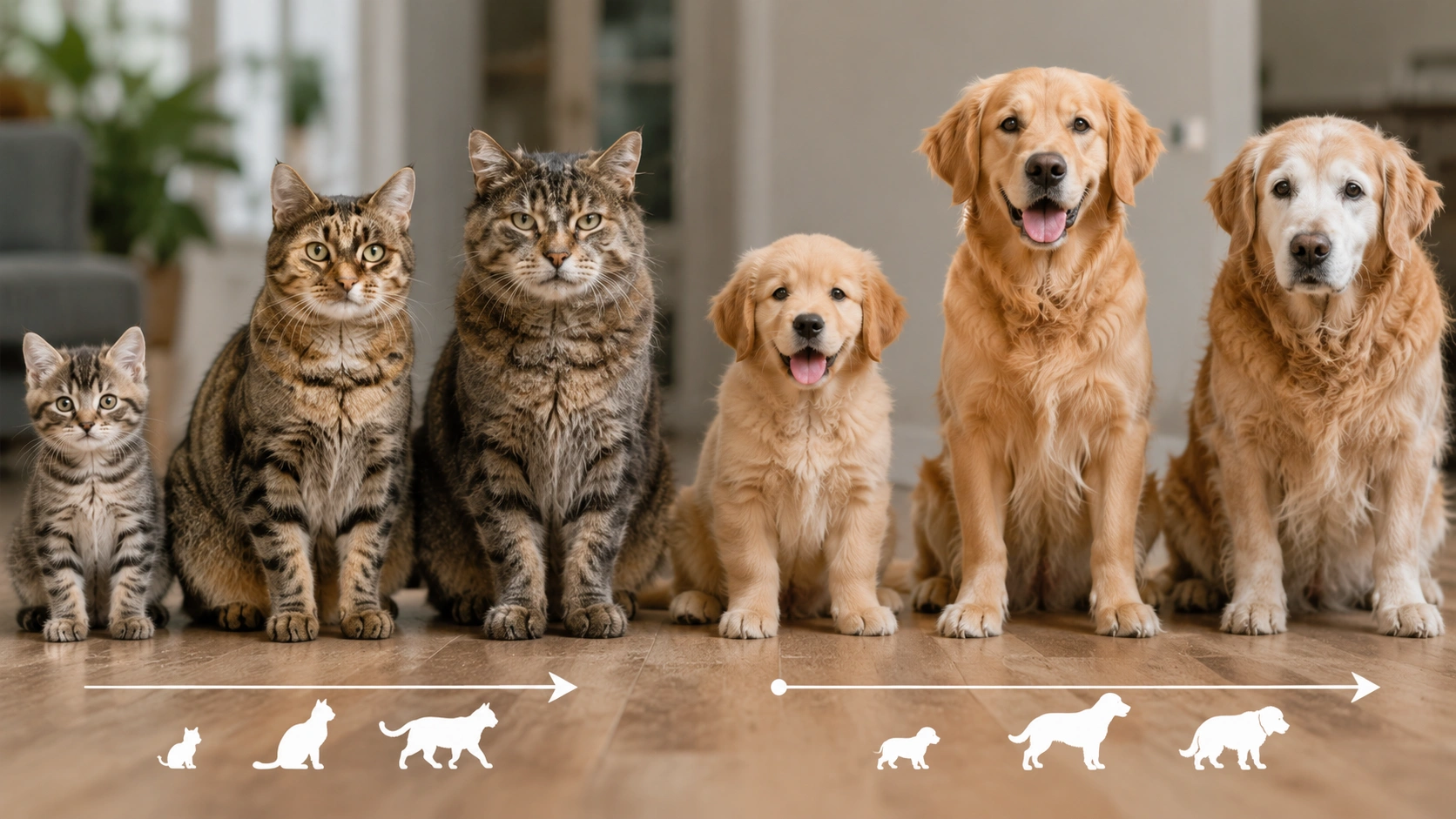
Are cat years the same as dog years? No, cat years and dog years are not exactly the same because cats and dogs age at different rates. Both terms help pet owners compare pet age in human years, but the comparison is only an estimate. The old idea that 1 pet year equals 7 human years is too simple and does not work well for every cat or dog.
Cats usually follow a more consistent aging pattern after their first two years. Dogs are more complicated because dog age in human years depends heavily on breed size, body type, and overall health. A small dog, like a Chihuahua, may age very differently from a giant breed dog, like a Great Dane or Irish Wolfhound.
This guide explains cat years vs dog years, why the 7-year rule is not accurate, how cat age charts and dog age charts work, and what pet age means for veterinary care, senior pet care, and everyday health.
Quick Answer: Are Cat Years the Same as Dog Years?
No, cat years are not the same as dog years. Cats and dogs do not age at the same rate, and their ages should not be calculated using one simple formula.
A cat’s first year is often compared to about 15 human years. By the end of the second year, a cat may be roughly equal to about 24 human years. After that, many cat age charts add about 4 human years for each extra cat year.
Dogs age differently. A dog’s first years also move quickly, but after that, size matters a lot. Small dogs often age more slowly later in life, while large dogs and giant breed dogs may reach senior stages earlier.
So, a 7-year-old cat is not always the same as a 7-year-old dog in human-age terms. A 7-year-old cat may be a mature adult or early senior, while a 7-year-old large dog may already be clearly senior. That is why a cat and dog age comparison chart is more helpful than the old 7-year calculation.
What Are Cat Years and Dog Years?
Cat years and dog years are simple ways to describe a pet’s age compared with human years. They help pet owners understand whether a pet is like a child, teenager, adult, mature adult, senior, or geriatric animal.
For example, a 1-year-old cat is not like a 1-year-old human child. A 1-year-old cat is often closer to a teenager in development. The same idea applies to a 1-year-old dog, although the exact comparison can change depending on the dog’s size and breed.
The goal of using pet years is not to find an exact scientific number. Instead, it helps pet parents understand life stages, average lifespan, and care needs. A pet’s human equivalent age can guide choices around diet, exercise, dental care, weight management, and vet visits.
This matters because pets age faster than humans in the early part of life. Puppies and kittens grow quickly, reach adulthood faster, and may become seniors sooner than many people expect. Understanding pet age in human years helps owners give better care at the right time.
Why the 7-Year Rule Is Not Accurate
Many people have heard that 1 dog year equals 7 human years or that 1 cat year equals 7 human years. This is known as the 7-year rule, but it is only a rough myth.
The problem is that cats and dogs do not age in a straight line. They age very quickly during their first one or two years, then the aging process slows into a more steady pattern. That means the first year of a cat’s life or dog’s life cannot be compared to only 7 human years.
For cats, the first year is often estimated at about 15 human years, and the second year brings the cat to about 24 human years. After that, each extra year may add about 4 human years.
For dogs, the situation is even more flexible. A small dog, medium dog, large dog, and giant dog may all have different aging patterns. A Chihuahua and a Great Dane may be the same calendar age, but they may not be at the same life stage.
So, the 7-year calculation is easy to remember, but it does not represent real pet aging very well. A better approach is to use a cat age chart, a dog age chart, and your veterinarian’s advice.
Cat Years vs Dog Years: The Main Difference
The main difference between cat years vs dog years is consistency. Cat years are more consistent than dog years, while dog years depend on breed and size.
Most healthy cats are similar in body size compared with dogs. Because of that, a general cat age in human years chart can work fairly well for many cats. Of course, lifestyle still matters. Indoor cats may have different risks than outdoor cats, and health conditions can change how a cat ages.
Dogs vary much more. A toy dog, medium dog, large dog, and giant breed dog can have very different lifespans. Small dogs often live longer than large dogs, while giant breeds may enter the senior stage earlier.
This is why dog age in human years should not be calculated with one simple rule. A 7-year-old small dog may still seem active and middle-aged, while a 7-year-old giant breed dog may already need senior wellness care.
In simple terms, cats and dogs both age quickly in early life, but after that:
| Pet Type | Aging Pattern |
| Cats | More consistent after the first two years |
| Small dogs | Often age more slowly later in life |
| Large dogs | Often reach senior stages earlier |
| Giant dogs | Usually age fastest among dogs |
This is the key reason cat age vs dog age can be confusing.
How Cat Years Work in Human Years
A common cat years to human years guide works like this: the first year of a cat’s life equals about 15 human years, the second year brings the cat to about 24 human years, and each year after that adds about 4 human years.
Here is a simple cat age chart:
| Cat Age | Approximate Human Age | Life Stage |
| 1 year | 15 human years | Junior |
| 2 years | 24 human years | Adult |
| 3 years | 28 human years | Adult |
| 5 years | 36 human years | Adult |
| 7 years | 44 human years | Mature |
| 10 years | 56 human years | Senior |
| 15 years | 76 human years | Geriatric |
This chart is only an estimate, but it helps explain how cats age. A 5-year-old cat is not “old,” but it is no longer a young kitten. A 10-year-old cat may be considered a senior, even if it still plays, jumps, and acts energetic.
Cat life stages often include kitten, junior, adult, mature, senior, and geriatric. These stages are useful because each one has different care needs. A kitten needs growth support and social skills. An adult cat needs weight control, dental care, and regular checkups. A senior cat may need closer monitoring for arthritis, dental disease, kidney issues, weight changes, and behavior changes.
How Dog Years Work in Human Years
Dog years to human years are harder to calculate because dogs do not all age the same way. Breed size is one of the biggest factors.
Small dogs, such as Chihuahuas and Jack Russell Terriers, often live longer and may stay active for more years. Large dogs, such as German Shepherds or St Bernards, may reach senior stages earlier. Giant breeds, such as Great Danes and Irish Wolfhounds, often age faster than small breeds.
A simple dog age chart may look like this:
| Dog Age | Small Dog Estimate | Medium Dog Estimate | Large Dog Estimate |
| 1 year | 15 human years | 15 human years | 15 human years |
| 2 years | 24 human years | 24 human years | 24 human years |
| 5 years | 36 human years | 37 human years | 40 human years |
| 7 years | 44 human years | 47 human years | 50+ human years |
| 10 years | 56 human years | 60 human years | 66+ human years |
| 12 years | 64 human years | 69 human years | 77+ human years |
This is why how dogs age based on breed and size is so important. A small dog may not be considered senior until around 10–12 years, while a medium dog may become senior around 7–8 years, and a large dog may be senior around 5–6 years.
The dog’s actual health matters too. Diet, exercise, genetics, dental care, body condition, and preventive care all affect the aging process.
Cat Years vs Dog Years Chart
A side-by-side cat years vs dog years chart can make the comparison easier. Remember, this table is only an estimate. Your pet’s real health may be different from the chart.
| Pet Age | Cat Human-Age Estimate | Small Dog Estimate | Medium Dog Estimate | Large Dog Estimate | General Life Stage |
| 1 year | 15 | 15 | 15 | 15 | Young adult |
| 2 years | 24 | 24 | 24 | 24 | Adult |
| 5 years | 36 | 36 | 37 | 40 | Adult / mature |
| 7 years | 44 | 44 | 47 | 50+ | Mature / senior |
| 10 years | 56 | 56 | 60 | 66+ | Senior |
| 12 years | 64 | 64 | 69 | 77+ | Senior / geriatric |
| 15 years | 76 | 76 | 83+ | 90+ | Geriatric |
This cat and dog age comparison chart shows why the same calendar age does not always mean the same life stage. A 10-year-old cat and a 10-year-old small dog may be somewhat similar in human-age estimates, but a 10-year-old large dog may be much older in health terms.
A chart is useful, but it should not replace a veterinary checkup. Your veterinarian can look at your pet’s teeth, body condition, mobility, organ function, and overall health.
Pet Life Stages Matter More Than Exact Numbers
While age charts are helpful, pet life stages often matter more than exact numbers. A pet’s life stage tells you what kind of care, food, exercise, and health screening may be needed.
Common cat and dog life stages include:
| Life Stage | Cats and Dogs May Need |
| Kitten / Puppy | Vaccines, growth support, training, social skills |
| Junior | Healthy development, behavior support, exercise |
| Adult | Weight control, dental care, yearly vet exams |
| Mature | Early screening, diet review, joint monitoring |
| Senior | More regular checkups, bloodwork, mobility support |
| Geriatric | Comfort care, close monitoring, quality of life support |
This is why cat life stages and dog life stages are useful for pet owners. A number on a chart is only one part of the story. A pet’s activity level, appetite, sleep patterns, weight, dental health, and behavior changes also matter.
For example, a senior dog that still walks happily, eats well, and has a healthy weight may have a good quality of life. A younger pet with dental disease, arthritis, or weight problems may need extra care earlier than expected.
Why Pet Age Matters for Health and Vet Care
Knowing your pet’s age in human years is not just a fun fact. It helps guide veterinary care, preventive care, and daily routines.
As cats and dogs age, their healthcare needs can change. Older pets may need closer attention to dental disease, arthritis, weight management, organ function, thyroid levels, vision issues, hearing issues, and mobility issues. Your veterinarian may recommend health screenings, bloodwork, urinalysis, dental exams, or arthritis screening depending on your pet’s age and condition.
Pet age can also affect food choices. A growing puppy or kitten needs different nutrition from an adult pet. A senior cat or senior dog may need food that supports healthy weight, digestion, joints, or kidney health.
Exercise also changes with age. Young pets may need more play and training. Mature pets may need steady activity to prevent weight gain. Senior pets may need gentle movement, shorter walks, softer bedding, and mobility support.
The goal is not to worry about aging. The goal is to use age as a guide for better care. When you understand your pet’s life stage, you can help protect their quality of life.
Signs Your Cat or Dog May Be Getting Older
Aging can look different in every pet. Some cats and dogs stay playful for many years, while others slow down earlier. Still, there are common signs of aging in pets that owners should notice.
Your cat or dog may be getting older if you see changes such as sleeping more than usual, moving slowly, gaining or losing weight, cloudy eyes, hearing changes, bad breath, tartar buildup, missing teeth, or stiffness after rest. Some pets may also show behavior changes, such as confusion, anxiety, less interest in play, or changes in social habits.
Cats may show aging through litter box changes, hiding more often, grooming less, or jumping less. Dogs may show aging through shorter walks, trouble climbing stairs, less energy, or signs of joint pain.
Aging does not always mean illness, but sudden changes should not be ignored. Weight loss, appetite changes, mobility problems, blindness, deafness, or cognitive dysfunction should be discussed with a veterinarian.
The earlier you notice these changes, the easier it may be to support your pet with diet changes, dental care, pain management, mental stimulation, or a better daily routine.
Helpful Tips for Using Cat and Dog Age Charts Correctly
A pet age calculator, cat age calculator, or dog age calculator can be helpful, but it is not perfect. These tools give estimates, not medical answers.
Use a cat chart for cats and a dog chart for dogs. Do not use the same chart for both. Also, if you use a dog age calculator, choose one that considers small dogs, medium dogs, large dogs, or giant breed dogs. A calculator that ignores breed size may give a less useful result.
If you adopted a rescue pet or shelter pet and do not know the exact birth date, a veterinarian may estimate age through a physical exam. They may look at the teeth, tartar buildup, missing teeth, eyes, coat condition, body condition, mobility, and behavior. It is usually easier to estimate age in puppies and kittens than in older animals.
One common mistake is thinking a senior pet is automatically unhealthy. That is not true. Many senior cats and dogs live happy, active lives with the right care. Another mistake is waiting until symptoms appear before scheduling a vet visit. Preventive care is often easier and less stressful than treating problems late.
Use age charts as a guide, but use your pet’s health, behavior, and veterinary advice as the real decision-maker.
Senior Pet Care Checklist for Cats and Dogs
Senior pet care should focus on comfort, prevention, and quality of life. Cats and dogs may become senior at different ages, and dogs may enter senior life earlier or later depending on size.
Large dogs may be senior at around 5–6 years, medium dogs around 7–8 years, and small dogs around 10–12 years. Cats are often considered senior around later adult years, though each cat is different.
A simple senior care checklist includes:
| Care Area | Why It Matters |
| Regular vet exams | Helps catch health issues early |
| Weight monitoring | Prevents stress on joints and organs |
| Dental care | Reduces pain, infection, and bad breath |
| Joint support | Helps with arthritis and mobility issues |
| Bloodwork and urinalysis | Checks organ function and hidden illness |
| Diet review | Supports healthy weight and senior nutrition |
| Mental stimulation | Helps reduce boredom and cognitive decline |
| Comfort at home | Soft beds, easy food access, and safe movement |
For older cats, watch for appetite changes, litter box problems, weight loss, grooming changes, and jumping difficulty. For older dogs, watch for stiffness, slower walks, weight gain, dental problems, and behavior changes.
A senior wellness exam can help your veterinarian recommend the right care plan.
FAQs About Cat Years and Dog Years
Are cat years calculated the same as dog years?
No. Cat years and dog years are calculated differently because cats and dogs age in different ways. Cat aging is usually more consistent, while dog aging depends strongly on breed size.
Is one cat year the same as one dog year?
Not exactly. 1 cat year and 1 dog year may both represent fast early growth, but they do not always equal the same human equivalent age, especially after the first two years.
Do cats age faster than dogs?
Cats age quickly in the first two years, but that does not always mean they age faster than dogs overall. Many large and giant dogs reach senior stages earlier than cats.
Do dogs age faster than cats?
Some dogs do, especially large dogs and giant breed dogs. Small dogs often age more slowly later in life and may live longer than larger breeds.
When is a cat considered senior?
Many cats are considered senior in later adult years, often around 10 years, although health can vary. Some cats remain active and playful well into their senior stage.
When is a dog considered senior?
It depends on size. Large dogs may be senior around 5–6 years, medium dogs around 7–8 years, and small dogs around 10–12 years.
Should I use a cat age chart or dog age chart?
Use a cat age chart for cats and a dog age chart for dogs. For dogs, choose a chart that considers breed size.
Conclusion
So, are cat years the same as dog years? No, they are not the same. Cat years vs dog years can be confusing because cats and dogs age differently, and dogs vary widely by breed size. The 7-year rule is only a rough myth, not an accurate way to understand pet age in human years.
The best approach is to use age charts as helpful guides, pay attention to your pet’s life stage, and work with your veterinarian. Whether you have a kitten, puppy, adult pet, senior cat, or senior dog, understanding pet age can help you make better choices for health, comfort, and long-term quality of life.
Disclaimer: This article is for general pet care information only. Age comparisons and charts are estimates and may vary based on breed, size, and health. Always consult a veterinarian for accurate advice about your pet’s health and care.