
What is the meaning behind the danza of los viejitos? At its core, the Danza de los Viejitos—often translated as the Dance of the Little Old Men—is a traditional folk dance from Michoacán, Mexico that combines Purépecha cultural heritage, symbolic respect for elders, ritual roots, and later layers of humor and theatrical performance. Multiple sources connect the dance to pre-Hispanic traditions and to offerings or homage to an Old God / fire or sun deity, while later descriptions also explain its comic style and its transformation into a broader folkloric performance.
That layered meaning is what makes this dance so interesting. It is not just a performance where dancers wear masks and move like elderly men. It is also a cultural expression tied to memory, age, resilience, ancestry, harvest symbolism, and regional identity. In modern performances, people often notice the humor first—the bent backs, canes, masks, and sudden bursts of energetic footwork—but behind that visual contrast is a deeper story about Michoacán, Purépecha tradition, and the way communities keep heritage alive across generations.
What Does Danza de los Viejitos Mean?
The literal meaning of Danza de los Viejitos is “Dance of the Little Old Men” or “Dance of the Old Men.” But the cultural meaning goes much further than the title. The “old men” imagery is usually understood as representing elders, wisdom, age, experience, and continuity, while the dance itself blends seriousness and humor in a way that is common in living folk traditions. Some sources frame it as a celebration of the elderly and a reminder to honor those who came before, while others connect it to earlier ritual practices and symbolic appeals for harvest or spiritual favor.
So when people ask about the danza de los viejitos meaning, the best answer is that the dance carries multiple meanings at once. It can symbolize respect for elders, the cycle of life, endurance despite age, and community memory. It can also be read as a performance about hidden strength: dancers appear frail and elderly at first, then suddenly move with speed and force. That contrast gives the dance emotional power and helps explain why it remains one of the most recognizable folk traditions of Michoacán.
Origin of the Danza de los Viejitos in Michoacán
The dance is strongly associated with Michoacán, especially the Purépecha region and the Lake Pátzcuaro area. Several descriptions trace the dance back to pre-Hispanic times and connect it to the Purépecha people, while one source specifically notes a tradition that places its origin in Jarácuaro in the Lake Pátzcuaro region. Another source explains that the dance is said to have been performed by four men, sometimes representing the natural elements and agricultural symbolism, especially in relation to corn and harvest.
This matters because the origin and meaning of danza de los viejitos are closely linked. In the older interpretation, the dance was not just entertainment. It was part of a ritual world in which performance, spirituality, agriculture, and community life were connected. Sources differ on some details, and not every retelling matches exactly, but there is a consistent pattern: the dance is treated as an old Purépecha tradition with sacred or ceremonial roots that later adapted to changing historical and social conditions.
A later layer of interpretation appears after colonization. One common explanation says that after Spanish influence, the dance was “modernized” and came to include elements of parody, especially the exaggerated portrayal of elderly men and, in some accounts, a humorous imitation of old Spanish men. That does not cancel the older spiritual meaning. Instead, it shows how a traditional dance can absorb new meanings over time while still preserving its local identity.
Why Do Young Dancers Dress as Old Men?
One of the most common questions is simple: why do dancers wear old-man masks in Danza de los Viejitos? The answer lies in symbolism and performance. The image of old age can represent wisdom, survival, memory, and authority, but it can also create humor. Dancers may appear bent over, shaky, or dependent on canes, only to suddenly reveal agility and power. This makes the dance memorable while also turning age itself into a dramatic and meaningful character.
In some interpretations, the portrayal of old men reflects respect for elders and the social value of experience. In others, the comic exaggeration suggests a parody of age or a colonial-era mockery of outsiders. The strength of the tradition is that it can hold both ideas. It can be playful on the surface and still carry a serious message underneath. That is one reason the symbolism of danza de los viejitos feels richer than a simple costume dance.
Symbolism of the Mask, Cane, Hat, and Clothing
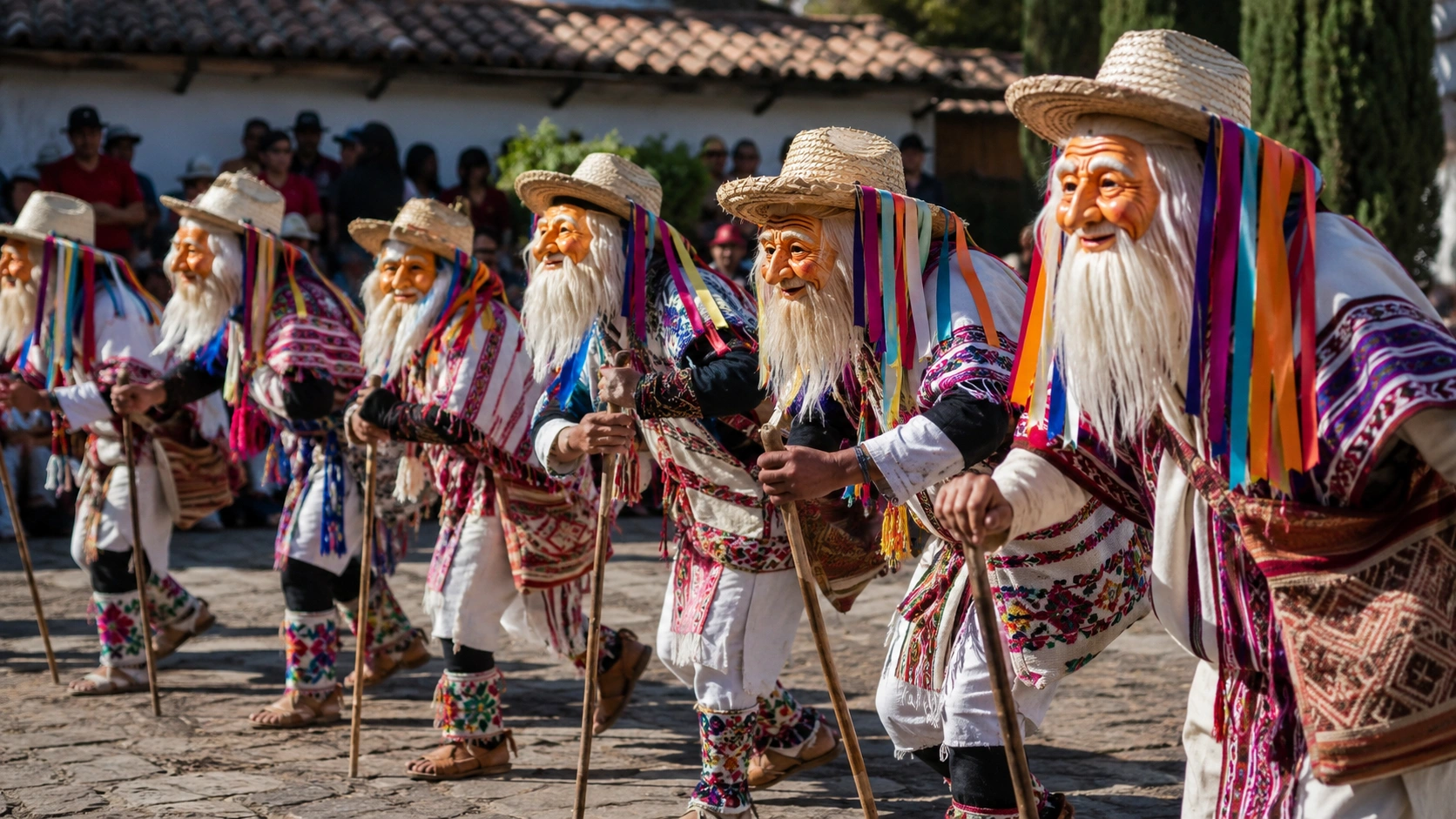
The costume is one of the most important parts of the dance, and each element helps answer what does Danza de los Viejitos symbolize. The mask usually shows the face of an elderly man, often with wrinkles, gray hair, and a smiling or expressive look. Depending on the source, these masks may be made from wood, clay, or even cornstalk paste. The mask makes old age visible and theatrical, allowing the dancer to embody an elder figure even if the performer is young.
The cane is just as important. At first, it supports the illusion of age and weakness. The dancers lean on it, shuffle slowly, and seem physically limited. But once the movement changes, the cane becomes part of the performance rhythm and contrast. In that sense, the meaning of the cane in Danza de los Viejitos is not only about frailty. It also helps dramatize transformation, resilience, and the idea that apparent weakness may hide strength.
The straw hat, white clothing, bright ribbons, and, in some descriptions, brightly colored pants or campesino clothing, connect the dance to rural identity, local style, and regional character. The wooden-soled footwear is especially notable because it creates a tapping or stomping sound that becomes part of the dance’s musical effect. Together, the costume does more than decorate the dancers. It helps tell the story of the dance through visual symbols tied to Michoacán, Purépecha heritage, and folk performance tradition.
Quick Symbolism Table
| Element | Common meaning or function |
| Old-man mask | Age, memory, wisdom, humor, theatrical identity |
| Cane | Frailty at first, then contrast, rhythm, resilience |
| Straw hat with ribbons | Regional identity, folk costume, visual tradition |
| White clothes / shirts | Traditional costume associated with the dance |
| Wooden shoes / soles | Sound, rhythm, stomping effect, performance energy |
The exact interpretation can vary by community and performer, but this symbolic reading matches the broad patterns that appear across multiple descriptions of the dance.
What the Dance Movements Represent
The most famous feature of the dance is its change in movement. At the beginning, the dancers often move as if they are elderly: hunched over, slow, careful, and dependent on their canes. Then, suddenly, the performance shifts into vigorous footwork, stomping, and agile movement. This contrast is one of the clearest clues to the dance’s meaning. It turns aging into a dramatic performance and suggests that strength, spirit, and vitality remain alive even when the body appears weak.
That is why the meaning of the slow-to-fast movement in the dance is so important. The movement can be read as humor, because the surprise is funny. It can also be read as a statement about endurance, because the dancers prove they are stronger than they first appear. Some descriptions even connect the dance to a deeper struggle against decline or death, turning the stomping and energetic movement into a symbolic refusal to give in. Even where interpretations differ, the contrast between weakness and force is central.
Music and Performance Style
The music gives the dance its energy and shape. Across sources, the most common instruments named are violin, guitar, and, in some versions, clarinet, tambourine, drums, or other wind instruments. The rhythm helps the dancers move from the slow opening gestures into the more animated sections, and the sound created by wooden footwear adds another layer to the performance.
Music matters here because the Danza de los Viejitos is not only symbolic—it is also deeply performative. The melodies support the mood, the comedy, and the sudden bursts of motion. In many folk traditions, music and dance are inseparable, and that is especially true here. The violin and guitar do more than accompany the dancers; they help create the identity of the piece as a living, recognizable tradition from Michoacán.
“It is a tradition that is passed from generation to generation in his family.”
That brief description from a traditional-dance program captures something important: the dance is not just watched. It is learned, repeated, and handed down.
Is It a Religious Dance, a Folk Dance, or Both?
A strong article about the history of Danza de los Viejitos should make one thing clear: it is reasonable to understand the dance as both a folk dance and a tradition with older sacred or ritual associations. Sources repeatedly mention pre-Hispanic origins, the Old God, and ceremonial intentions such as good harvests or spiritual connection. At the same time, modern descriptions often present it as a colorful public dance, a folkloric performance, and a cultural symbol of the region.
This is exactly where many shorter articles become confusing. They treat the dance as either entirely ritual or entirely comic. In reality, traditional practices often evolve. A dance can begin in sacred settings, absorb colonial influence, develop humorous elements, and still remain culturally serious. That is the best way to explain the difference between ritual meaning and folkloric performance without flattening the tradition into a single simple label.
Is Danza de los Viejitos Connected to Day of the Dead?
People often associate the dance with Day of the Dead because Michoacán is one of the best-known regions for Día de Muertos traditions, especially around Lake Pátzcuaro. But the dance should not be reduced to a Day of the Dead performance alone. Sources link it more broadly to regional celebrations, cultural festivals, and, in one case, seasonal observances such as Christmas, New Year’s Eve, and Candelaria Day.
So the careful answer is this: the dance may appear in the wider cultural environment that people connect with Michoacán and seasonal festivities, but its meaning is broader than a single holiday. It belongs to a larger tradition of Purépecha identity, regional folklore, and intergenerational cultural memory.
Why the Dance Still Matters in Michoacán Today
The modern importance of the dance is one of the biggest content gaps in many competitor articles. Why does Danza de los Viejitos still matter in Michoacán today? Because it is a visible way of preserving Purépecha heritage, teaching younger generations about regional culture, and keeping local identity alive in both community and public performance settings. A Tennessee folklife program describes the dance as something learned from grandparents and practiced for years, which highlights its role in family and community transmission.
Educational and workshop contexts show another side of that living tradition. A Sones de México program uses mask-making, dance, and music activities to teach children about the tradition and the state’s history, even noting participation for groups of up to twenty elementary school students. That kind of example matters because it shows the dance is not trapped in the past. It continues to function as a way of teaching culture, performance, and history in the present.
Here is a simple way to think about its present-day importance:
- It preserves regional identity
- It honors ancestry and elders
- It keeps performance traditions active
- It helps younger generations learn cultural history
- It represents Michoacán in Mexico and beyond
Even in modern public performances, the dance still carries the same core appeal: it is visually striking, emotionally layered, and culturally rooted.
A Brief Case Study: Why This Dance Stands Out
Many folk dances are admired for costume or rhythm. Danza de los Viejitos stands out because it combines visual symbolism, movement contrast, regional identity, and historical layering all at once. A viewer can enjoy it as a lively dance, a child can understand its humor, and a more curious reader can trace it back to Purépecha ritual history and community meaning. That unusual mix helps explain why the dance appears so often in articles about Michoacán culture and Mexican folk traditions.
Simple Summary: The Meaning Behind Danza de los Viejitos
If you want the clearest possible answer, here it is: the meaning behind the danza of los viejitos is a combination of respect for elders, Purépecha cultural memory, ritual or spiritual roots, humor, and community identity. The old-man masks, canes, hats, and wooden shoes are not random props. They help tell a story about age, endurance, performance, and heritage. The slow beginning and sudden energetic movement make that story visible in a way that audiences instantly remember.
That is also why the dance remains important. It is not only a tradition from the past. It is a living expression of Michoacán, Purépecha identity, and the ability of culture to carry multiple meanings at once—serious and playful, sacred and public, old and still alive.
Frequently Asked Questions About Danza de los Viejitos
What does Danza de los Viejitos mean in English?
It usually means “Dance of the Little Old Men” or “Dance of the Old Men.”
Where did Danza de los Viejitos originate?
It is associated with Michoacán, Mexico, especially the Purépecha region and the Lake Pátzcuaro area. Some traditions specifically point to Jarácuaro.
Why do the dancers wear masks and canes?
The masks and canes help portray elderly men, which supports the dance’s themes of age, wisdom, humor, and performance contrast.
Is Danza de los Viejitos a religious dance?
It has pre-Hispanic ritual associations in many descriptions, but today it is also widely recognized as a folk dance and cultural performance.
Is it related to Day of the Dead?
It is connected more broadly to Michoacán cultural life and festivities than to a single holiday, though public interest may rise around well-known regional traditions like Día de Muertos.
Why is the dance still important today?
Because it continues to preserve regional culture, Purépecha heritage, and intergenerational tradition through performance, teaching, and community identity.
Disclaimer: This article is for general cultural and educational information only. Interpretations of traditions may vary by region, community, and source. For deeper understanding, refer to local experts or cultural authorities.