
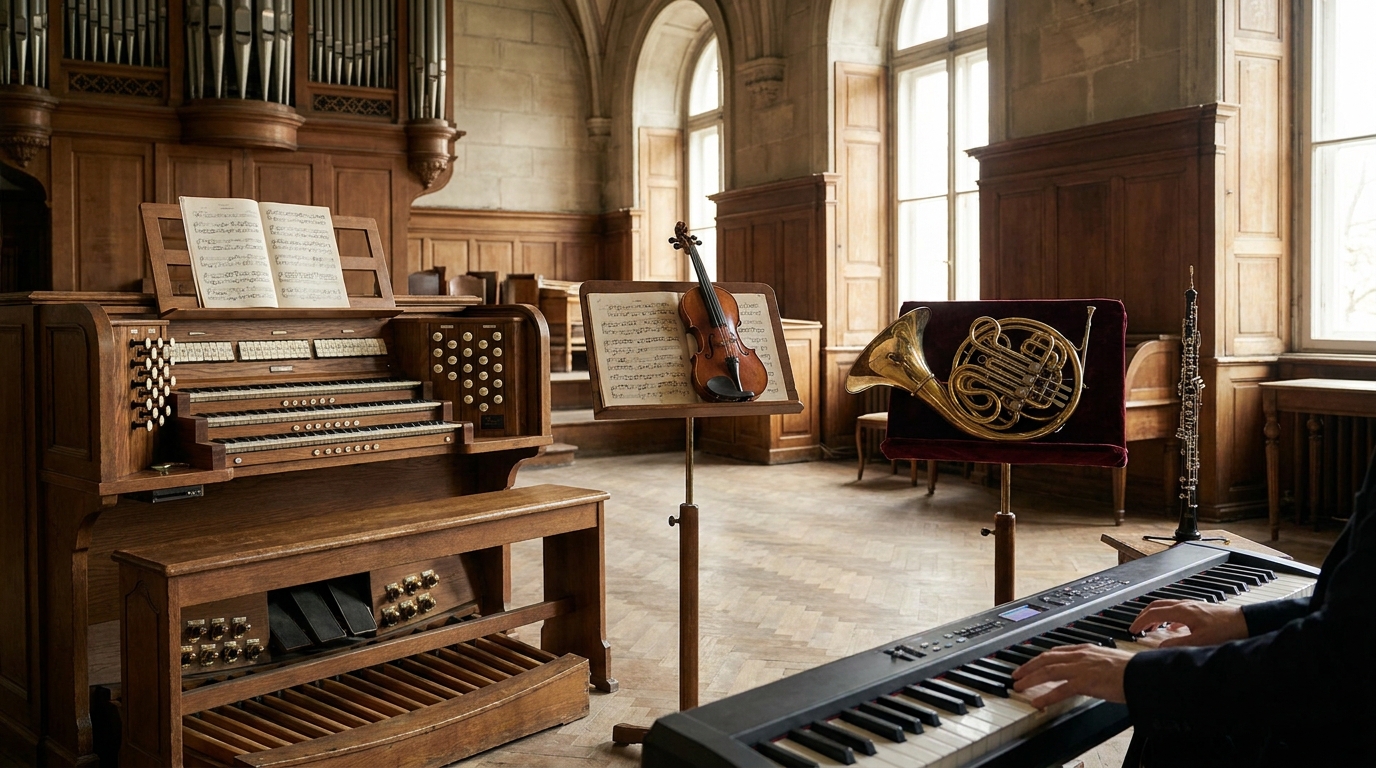
What is the hardest instrument to play? The honest answer is that there is no single instrument that is hardest for every person, but the oboe, violin, French horn, and organ are the instruments most often considered the toughest because they demand extreme precision, coordination, breath control, intonation, and years of dedicated practice.
That said, the idea of the hardest instrument to play depends on what kind of difficulty you mean. Some instruments are hard because they are difficult to sound good on quickly. Others are hard because they require intense physical stamina, advanced music theory knowledge, or the ability to coordinate both hands and even hands and feet at the same time. A few are also difficult because of maintenance, teacher availability, and the long road to true mastery.
So instead of giving a shallow one-line answer, this guide breaks down what makes an instrument hard to learn, compares the top contenders, and explains which instruments are hardest for beginners, hardest to master, and hardest to self-teach. If you have ever wondered whether violin is the hardest instrument to play, whether oboe is harder than violin, or whether organ is harder than piano, this article will give you a clear, practical answer.
The Short Answer: Which Instruments Are Usually Considered the Hardest?
When people ask what is the hardest instrument to play, the same names keep coming up: oboe, violin, French horn, organ, harp, accordion, bagpipes, drum kit, and double bass. These are the instruments most often described as the hardest instruments to learn, the hardest instruments to play, or the most difficult musical instruments to master.
For many musicians, oboe stands out because of its double reed, delicate embouchure, and unforgiving intonation. Violin is another leading answer because it has no frets, relies on exact finger placement, and makes even a small mistake easy to hear. French horn is often called the hardest brass instrument because tiny changes in lip tension can affect pitch dramatically. Organ is a different kind of beast altogether, with multiple keyboards, pedals, and multiple lines of music to read at once.
If you want the simplest verdict, here it is: the oboe and violin are usually the strongest all-around answers, while the organ may be the hardest in terms of multitasking and coordination, and the French horn is a top contender for sheer technical precision.
What Makes an Instrument Hard to Play?
To understand what makes an instrument hard to learn, you need a fair way to judge difficulty. Many articles mention the hardest musical instruments to learn, but not all of them explain the criteria clearly. The best way to evaluate the most difficult instruments to play is to look at several factors together.
The first is intonation. On instruments like the violin, double bass, and cello, players do not have frets to guide pitch. That means you must train your ear constantly and develop strong relative pitch. If your finger lands slightly off, the note sounds wrong right away.
The second is breath control and embouchure. This is where instruments like the oboe, bassoon, clarinet, bagpipes, and French horn become especially demanding. Producing a stable tone requires careful airflow, muscle control, and sometimes intense endurance. The oboe is a perfect example because its double reed is tiny, sensitive, and difficult to control.
The third factor is coordination. Some instruments require far more than simple hand movement. Drum kit players coordinate hands and feet independently. Organists often manage both hands, a pedalboard, and two staves or more at the same time. Accordion players must balance melody, rhythm, and bellows control together.
The fourth is physical challenge. Some instruments are simply demanding on the body. The harp has 47 strings and requires reach, finger strength, and pedal coordination. The double bass is physically large and can challenge posture and stamina. The French horn may look compact, but it demands serious facial endurance and control.
The fifth is the learning curve. Some instruments let beginners make a decent sound quickly. Others do not. This is why people often ask about the hardest instrument to sound good on. Instruments like oboe and violin can sound rough for a long time, which can be frustrating for beginners and lead to slow confidence growth.
Finally, there is maintenance and access to instruction. An instrument can be hard not just because of technique, but because it is hard to maintain, expensive to rent, or difficult to find a good teacher for. This is one reason the oboe and organ often appear high on lists of hardest instruments to learn.
Ranking the Hardest Instruments to Play
1. Oboe
If you ask many musicians what is the hardest instrument to learn, they will say oboe. The reason is simple: almost everything about it is demanding. The instrument uses a double reed made from two wooden blades, and that reed is incredibly sensitive. Small changes in breath pressure, lip position, or moisture can affect the sound and pitch.
On top of that, the oboe requires precise breath control, refined tongue articulation, and excellent intonation. Even producing a stable tone can take time. It is also one of the hardest instruments to self-teach because students benefit greatly from close feedback on tone, reed setup, and posture. For many beginners, the oboe is not just hard to master. It is hard to even sound comfortable on in the early stages.
2. Violin
The violin is one of the most famous answers to is violin the hardest instrument to play. It is not hard because it looks complex. It is hard because it leaves almost nowhere to hide. There are no frets, so pitch depends entirely on accurate finger placement and strong ear training. At the same time, your bow hand must control pressure, speed, and angle to create a clean tone.
This is why the violin is often called one of the most difficult instruments to play and one of the hardest instruments to make an acceptable sound on. A beginner can learn a few notes quickly, but producing a beautiful, centered tone is another challenge altogether. The violin also demands muscle memory, patience, and years of refinement.
3. French Horn
The French horn is widely seen as the hardest brass instrument. It uses only 3 valves, but that small number is misleading. Because the horn sits high in the harmonic series, players must hit notes with exceptional accuracy. Tiny changes in lip tension, embouchure, or airflow can throw off the pitch.
This makes the French horn one of the most punishing instruments for clean, consistent playing. It is also physically tiring, especially over long rehearsals and performances. The challenge is not just learning fingerings. It is controlling tone, pitch, and endurance under pressure. That is why the French horn deserves its place among the most difficult musical instruments to master.
4. Organ
If multitasking is your measure of difficulty, the organ may be the true winner. Many people ask is organ harder than piano, and in many ways the answer is yes. A pianist mainly uses two hands, but an organist often uses both hands and feet at the same time, sometimes across multiple keyboards and a pedalboard.
The organ also requires reading multiple lines of music, controlling registration, and thinking in layers. It is one of the few instruments where coordination, sight-reading, and structural thinking all collide at once. That makes it one of the most challenging instruments to learn and a very strong answer to hardest keyboard instrument.
5. Harp
The harp looks elegant, but it is much more complex than many people assume. With 47 strings and pedal changes that alter pitch, the instrument demands strong coordination and planning. Players must know exactly where their hands are going while managing a large range of notes and maintaining beautiful tone production.
The harp is also physically demanding. Posture matters, finger strength matters, and fluid movement matters. It is not always the first instrument people think of when they ask about the hardest instruments to play, but it absolutely belongs in the conversation.
6. Accordion
The accordion combines melody, rhythm, and movement in a way few instruments do. One hand plays keys or buttons, while the other manages accompaniment and bellows control. This makes the instrument a test of both hands, timing, and expressive balance.
What makes accordion difficult is not just coordination. It is the need to synchronize pitch, rhythm, dynamics, and airflow-like motion all at once. For that reason, it often appears on lists of hardest instruments to learn and play.
7. Bagpipes
The bagpipes are one of the most unusual answers to what makes an instrument hard to play, but the difficulty is real. Bagpipe players must maintain air pressure, control fingering, and keep tone stable while managing a continuous sound. Unlike some instruments where you can pause and reset easily, the bagpipes demand constant control.
They are also culturally specific and less widely taught than piano or guitar, which can make teacher availability more limited. That alone can make the learning process harder.
8. Drum Kit
Some people are surprised to see drum kit on a list of the hardest musical instruments to learn, but experienced musicians usually understand why it belongs here. Drummers often use hands and feet independently, maintain rhythm, switch patterns, and support the entire group’s timing.
Basic beats can come fairly quickly, which is why drums are not always the hardest instrument to start. But advanced drumming requires serious coordination, timing, endurance, and feel. So while it may not be the hardest instrument for beginners in the first week, it is definitely one of the hardest instruments to master.
9. Double Bass
The double bass is physically large, awkward for some beginners, and demanding in terms of tone and posture. Like the violin, it is fretless, so players must rely on ear training and precise movement. Add in the challenge of thick strings, stretching, and bow control, and you get one of the more physically taxing instruments in music.
The double bass is a great example of an instrument that combines physical challenge, intonation, and stamina. It does not always win the title of hardest instrument to play, but it deserves respect.
10. Bassoon or Clarinet
The final slot could go to bassoon or clarinet, depending on how broad you want the ranking to be. The bassoon brings awkward fingerings, breath demands, and reed-related issues. The clarinet may be slightly more beginner-accessible, but advanced clarinet playing still requires control, tone refinement, and musical precision.
Both belong in the wider conversation around difficult musical instruments, especially when comparing woodwind instruments by technique and tone production.
Hardest to Learn vs. Hardest to Master
One reason this topic causes so much debate is that hardest to learn and hardest to master are not always the same thing. Some instruments are hard from day one. Others feel approachable at first but become incredibly difficult at advanced levels.
The oboe and violin are examples of instruments that are hard early and stay hard. Beginners struggle to make a clean, stable sound, and advanced players still face huge technical demands. Piano, by contrast, is often more beginner-friendly. A new student can play simple songs quickly, but true piano mastery takes years. The same goes for drums. Basic rhythm patterns may come early, but top-level independence, groove, dynamics, and control are much harder.
So when someone asks about the hardest instrument to play professionally, the answer may be different from the hardest instrument for a beginner. That distinction matters.
Which Instrument Is Hardest for Beginners?
If your question is what is the hardest instrument for beginners, the answer usually shifts toward instruments that are difficult to sound good on right away. That puts oboe, violin, and French horn near the top.
The oboe is hard because of reed sensitivity, breath control, and the slow path to a stable tone. The violin is hard because beginners must manage pitch and bowing at the same time. The French horn is hard because even simple notes can be unstable without refined embouchure control.
By contrast, instruments like piano or even drum kit can feel more rewarding at the beginning, even if they still become very challenging later. This is why the hardest instrument to learn for beginners is not always the same as the hardest instrument overall.
Instrument Difficulty Chart
Here is a simple side-by-side comparison of the top contenders:
| Instrument | Hard to Start? | Hard to Master? | Biggest Challenge | Extra Barrier |
| Oboe | Very high | Very high | Double reed, breath control, intonation | Reed maintenance, teacher access |
| Violin | Very high | Very high | Bowing technique, intonation, fretless pitch | Slow tone development |
| French horn | High | Very high | Embouchure, pitch accuracy, endurance | Precision under pressure |
| Organ | High | Very high | Hands and feet, multiple keyboards, reading complexity | Access to instrument |
| Harp | High | Very high | 47 strings, pedals, coordination | Cost and size |
| Accordion | Medium-high | High | Bellows, both hands, rhythm balance | Coordination load |
| Drum kit | Medium | Very high | Limb independence, timing | Advanced coordination |
| Double bass | High | High | Intonation, posture, thick strings | Physical size |
This kind of instrument difficulty chart helps answer the question more usefully than a simple ranked list because it shows why each instrument is difficult.
Violin vs. Oboe vs. French Horn vs. Organ: Which Is Hardest, Really?
If you want a final showdown, these four are the most interesting to compare.
The oboe may be the hardest for breath control, tone stability, and maintenance. The double reed makes it unusually unforgiving, and many students need close instruction early on.
The violin may be the hardest for intonation and tone production. Because it is fretless and highly exposed, even small mistakes are obvious.
The French horn may be the hardest for brass precision. Its 3 valves do not make it easier. They make accuracy even more dependent on the player.
The organ may be the hardest for pure coordination and mental processing. Few instruments require such intense control of both hands, feet, and multiple musical layers at once.
So who wins? For most people, oboe and violin are the strongest answers to what is the hardest instrument to play. But if your definition of hard focuses on coordination, the organ has a serious case. And if you are only judging brass, French horn is the likely winner.
How Long Does It Take to Learn the Hardest Instruments?
A big part of this topic is really about time. People often ask how long does it take to learn the hardest instruments, but the better question is: learn to do what?
Making a first sound is not the same as playing beautifully. On many hard instruments, the timeline looks something like this: first sounds come early, basic control develops later, a decent tone takes longer, and true expressive mastery takes years of dedicated practice.
That is why the hardest instrument to sound good on is such an important idea. The oboe and violin often frustrate learners not because progress is impossible, but because the gap between “I can produce a note” and “I sound musical” can feel huge.
How to Choose a Hard Instrument That Is Still Right for You
Difficulty matters, but it should not be the only thing you consider. If you love the sound of the violin, oboe, harp, or French horn, that motivation can carry you through the early struggle. In many cases, passion matters more than picking the “easiest” option.
You should think about physical fit, access to a good teacher, your budget, and how patient you are with a long learning curve. A student with strong discipline and great instruction may thrive on an instrument that would frustrate someone else. This is why the best answer to which hard instrument should I choose depends on your goals.
A useful rule is this: choose the instrument whose sound makes you want to keep practicing, even on difficult days. That matters more than trying to avoid all challenge.
Why Learning a Difficult Instrument Is Worth It
There is something special about learning a hard instrument. Yes, it demands patience, humility, and resilience. But it also builds deep musicianship. Players learn to listen closely, solve technical problems, and develop real control over sound and expression.
That is why many musicians say learning a difficult instrument is a rewarding experience. The process teaches more than technique. It teaches persistence. And when a difficult instrument finally starts to respond the way you want, the sense of progress is powerful.
In that sense, the hardest musical instruments to learn can also become the most satisfying.
FAQ: What Else People Ask About the Hardest Instruments
Is violin the hardest instrument to play?
It is definitely one of the strongest contenders. The combination of intonation, fretless playing, and bowing technique makes it extremely demanding.
Is oboe harder than violin?
For many beginners, yes. The oboe can be harder at the start because of the double reed, sensitive tone production, and the challenge of controlling pitch and airflow.
Is French horn the hardest brass instrument?
For most musicians, yes. Its accuracy demands, embouchure sensitivity, and endurance make it one of the hardest brass instruments to play well.
Is organ harder than piano?
In many ways, yes. The organ adds pedals, multiple manuals, and more coordination demands than piano.
What is the hardest instrument to self-teach?
The oboe, French horn, and organ are among the hardest to self-teach because technique errors are easy to build and hard to fix without guidance.
What is the hardest instrument to sound good on?
The violin and oboe are top answers because beginners often need a long time before the sound becomes controlled and expressive.
Conclusion
So, what is the hardest instrument to play? For most readers, the best answer is oboe or violin, with French horn and organ close behind for different reasons. The oboe is brutally demanding in tone and control. The violin is unforgiving in pitch and bowing. The French horn punishes tiny errors. The organ challenges coordination like almost nothing else.
In the end, the hardest instrument to play depends on how you define difficulty. But if you are choosing an instrument for yourself, do not just ask what is hardest. Ask which sound, style, and musical path matter enough to keep you going through the hard parts. That is the answer that matters most.
Disclaimer: This article is intended for general informational and educational purposes only. Musical difficulty varies by individual skill, experience, physical ability, learning style, and access to instruction. The opinions shared about instrument difficulty are subjective and should not discourage anyone from learning the instrument they enjoy most.