
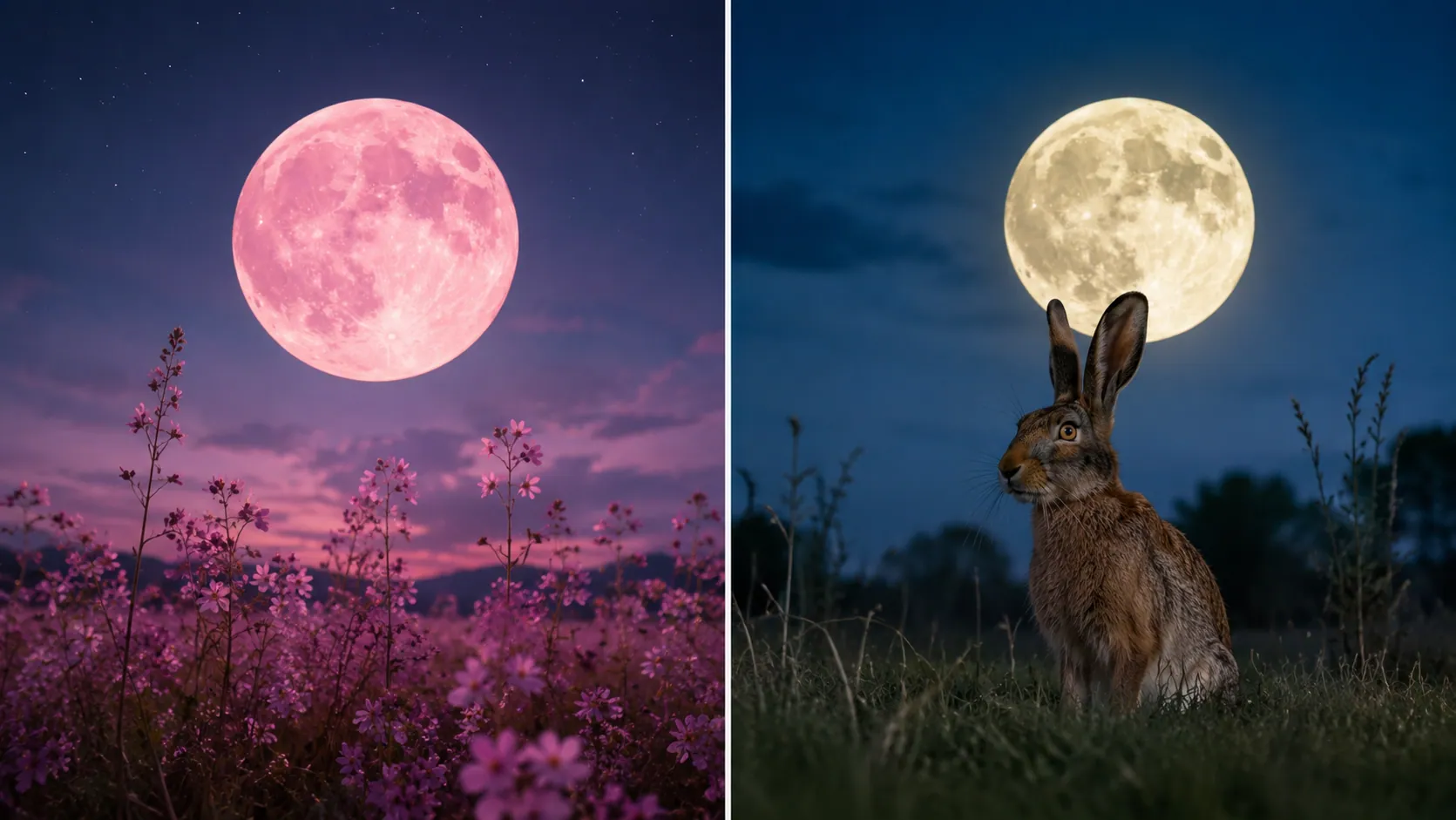
Is the hare moon the same as the pink moon? Not usually. In the most common full moon naming traditions, the Pink Moon refers to the April full moon, while the Hare Moon is more often connected with the May full moon, the Flower Moon, or broader spring folklore.
The confusion happens because both names are tied to spring, fertility, renewal, flowers, animals, and even Easter symbolism. Some modern spiritual sources may use Hare Moon as a general spring moon name, while traditional full moon calendars usually treat Pink Moon and Hare Moon as separate names.
In simple terms, the Pink Moon is mainly about early spring flowers, especially pink phlox or moss pink, while the Hare Moon is more about hares, rabbits, fertility, and spring animal activity. They share similar seasonal symbolism, but they are not always the same moon name.
Is the Hare Moon the Same as the Pink Moon?
The clearest answer is: No, the Hare Moon is not usually the same as the Pink Moon. The Pink Moon is widely known as the traditional name for the April full moon. The Hare Moon, however, is often listed as another name for the May full moon, sometimes alongside the Flower Moon, Corn Planting Moon, and Milk Moon.
That said, full moon names are not universal. Different cultures, regions, and spiritual traditions have used different names for the same lunar cycle. This is why one source may connect the Hare Moon with May, while another may mention it in relation to spring, Easter, or even the April full moon.
The key difference is that the Pink Moon meaning is strongly tied to spring wildflowers, especially Phlox subulata, also known as moss pink or creeping phlox. The Hare Moon meaning is more symbolic. It is connected to hares, rabbits, fertility, spring renewal, and the return of animal activity after winter.
So, if you are asking from a traditional moon-name calendar perspective, the answer is no. The Pink Moon is usually April’s full moon, while the Hare Moon is usually a different spring moon name. But if you are reading a modern spiritual or folklore-based source, the two may be connected symbolically because both belong to the broader world of spring full moon names.
Hare Moon vs Pink Moon: Quick Comparison
A simple comparison makes the difference easier to understand:
| Moon Name | Most Common Month | Main Meaning | Is It the Same? |
| Pink Moon | April | Named after pink phlox, moss pink, and early spring flowers | Usually separate from the Hare Moon |
| Hare Moon | Often May | Linked with hares, rabbits, fertility, and spring animal symbolism | Not usually the same as the Pink Moon |
| Flower Moon | May | Named for abundant spring flowers | Sometimes connected with the Hare Moon |
| Paschal Moon | March or April | The full moon used to help determine Easter | Can overlap with the Pink Moon |
| Egg Moon | April or spring | Linked with eggs, fertility, and new life | Symbolically related but not always identical |
The most important thing to remember is this: Pink Moon = April flowers. Hare Moon = spring animals, often May. Flower Moon = May blooms. Paschal Moon = Easter calculation.
This is why the phrase Hare Moon vs Pink Moon is really a question about moon names and meanings, not a question about two different astronomical events. Astronomically, a full moon is a full moon. Culturally, however, people have given full moons different names based on seasonal changes, plants, animals, weather, agriculture, and religious calendars.
What Is the Pink Moon?
The Pink Moon is the traditional name most commonly given to the April full moon. Despite the name, the Moon does not usually turn pink. The name comes from pink phlox, also called moss pink, wild ground phlox, or Phlox subulata, one of the early spring flowers that bloom in parts of North America.
This is one of the biggest misunderstandings about the Pink Moon meaning. Many people search “does the Pink Moon look pink?” because they expect the Moon to appear rosy or bright pink in the night sky. In reality, the name is seasonal. It points to what is happening on Earth during early spring, not to the Moon’s actual color.
The Moon can sometimes look orange, gold, or reddish near the horizon, especially at moonrise, because of the way Earth’s atmosphere scatters light. But that visual effect is separate from the traditional name Pink Moon.
The April Pink Moon is associated with early spring, spring blooms, renewal, fresh growth, and the natural world waking up after winter. Other names for April’s full moon can include Egg Moon, Seed Moon, Budding Moon, Growing Moon, Awakening Moon, Sprouting Grass Moon, and Fish Moon. These names all point to similar seasonal themes: new life, planting, animal movement, and the return of warmth.
So when someone asks, “Why is April’s full moon called the Pink Moon?”, the answer is simple: it is named after early blooming pink flowers, not because the Moon itself becomes pink.
What Is the Hare Moon?
The Hare Moon is a traditional or folklore-based full moon name linked to hares, rabbits, fertility, and spring animal activity. It is less standardized than the Pink Moon, which is why the term can appear differently depending on the source.
In many moon-name lists, the Hare Moon is connected with the May full moon. May is also widely known as the month of the Flower Moon, because flowers are usually blooming more fully by then. Some traditions list May’s full moon as the Flower Moon, while others also include names like Hare Moon, Corn Planting Moon, and Milk Moon.
The Hare Moon meaning is deeply connected to spring symbolism. Hares and rabbits have long been associated with fertility, speed, instinct, new life, and the seasonal return of abundance. This is also why hares and rabbits appear in many spring traditions, including Easter imagery.
However, the Hare Moon is not as fixed in popular almanac-style usage as the Pink Moon. Some modern spiritual, pagan, or folklore-based calendars may use Hare Moon as a spring moon name more flexibly. That flexibility is one reason people ask, “Is the Hare Moon in April or May?”
The best answer is that the Hare Moon is most often treated as a spring moon name, frequently connected to May, but sometimes symbolically linked with April because of Easter, eggs, rabbits, and fertility symbolism.
Is the Hare Moon in April or May?
The Hare Moon is most often associated with May, but it can sometimes appear in broader spring folklore connected to April. This is where much of the confusion begins.
In many common full moon naming systems, April’s full moon is the Pink Moon. May’s full moon is usually the Flower Moon, but some lists include Hare Moon as another May name. Because May is a time of strong spring growth, animal activity, and fertility symbolism, the name Hare Moon fits naturally there.
However, April also carries strong spring symbolism. April may include the Pink Moon, Egg Moon, Seed Moon, Sprouting Grass Moon, and sometimes the Paschal Moon, depending on the year. Since Easter often falls near the April full moon, and Easter is culturally linked with hares, rabbits, and eggs, some people assume the Hare Moon must be the same as the Pink Moon.
That assumption is understandable, but it is not always accurate.
A better way to say it is this: the Pink Moon is the standard name for April’s full moon, while the Hare Moon is a spring moon name often connected with May or with seasonal fertility folklore.
So if you are writing, researching, or explaining the difference, avoid saying the two names are always interchangeable. Instead, explain that they can overlap in symbolism, but they are usually different in traditional full moon calendars.
Why Do Full Moons Have Different Names?
Full moon names come from the way people used the Moon to track time, seasons, weather, plant growth, animal behavior, and agricultural cycles. Before modern calendars became common, the lunar calendar helped communities understand when to plant, harvest, hunt, travel, or prepare for seasonal changes.
That is why so many traditional full moon names are connected to nature. Names like Wolf Moon, Snow Moon, Worm Moon, Pink Moon, Flower Moon, Strawberry Moon, Buck Moon, Sturgeon Moon, Harvest Moon, Hunter’s Moon, Beaver Moon, and Cold Moon all describe something happening in the natural world.
But these names were not created by one single culture. They come from many sources, including Native American moon names, Colonial American moon names, European moon names, Celtic moon names, Anglo-Saxon moon names, Neo-Pagan moon names, and modern spiritual traditions. Because of this, there is no single universal list that everyone follows.
This explains why the same full moon can have different names. One tradition may call April’s full moon the Pink Moon, another may call it the Egg Moon, and another may connect it to planting, fishing, or spring growth. Likewise, May may be called the Flower Moon, Hare Moon, Corn Planting Moon, or Milk Moon.
The Moon itself is the same astronomical body, but the name reflects the culture, region, and seasonal meaning attached to it.
Pink Moon, Hare Moon, Flower Moon, and Paschal Moon: What’s the Difference?
The easiest way to understand the confusion is to compare the main spring moon names.
The Pink Moon is most commonly the April full moon. Its name comes from pink phlox and other early spring flowers. It is not called pink because of the Moon’s color.
The Hare Moon is a spring moon name associated with hares, rabbits, fertility, and animal activity. It is often linked to the May full moon or to the broader symbolism of spring.
The Flower Moon is the most common name for the May full moon. It reflects the abundance of flowers that appear as spring reaches its peak. Since the Hare Moon is also sometimes connected with May, the Hare Moon and Flower Moon are more closely related in many naming systems than the Hare Moon and Pink Moon.
The Paschal Moon is different. It is not mainly a nature-based moon name. It is connected to the calculation of Easter. In Christian tradition, Easter is tied to the first full moon after the spring equinox, often discussed around March 20 or March 21. Because this full moon often falls in March or April, the Paschal Moon can sometimes overlap with the Pink Moon.
The Egg Moon is another spring name, often linked to fertility, eggs, new life, and Easter-season symbolism. This is where eggs, hares, rabbits, and the Pink Moon can feel connected, even when the names come from different traditions.
In short: Pink Moon is floral, Hare Moon is animal-symbolic, Flower Moon is May-bloom focused, and Paschal Moon is Easter-calendar focused.
How Easter, Eggs, and Hares Add to the Confusion
The connection between the Pink Moon, Hare Moon, and Easter is one of the main reasons people mix these names together.
Easter is a movable holiday, meaning it does not fall on the same calendar date every year. Its timing is connected to the spring equinox and the Paschal Moon, often described as the first full moon after the spring equinox. This means Easter often falls close to a March or April full moon.
Because the Pink Moon is usually the April full moon, it is often discussed near Easter. At the same time, Easter traditions include eggs, rabbits, and sometimes older spring symbols connected with fertility, rebirth, and new life. This creates a natural symbolic bridge between the Pink Moon, the Egg Moon, and the Hare Moon.
However, symbolism is not the same as a formal moon-name calendar. A hare may symbolize spring and fertility, but that does not automatically make the Hare Moon the same as the Pink Moon.
A useful way to understand it is this: Easter explains why people connect hares with the April full moon, but traditional moon-name lists do not always identify the April Pink Moon as the Hare Moon.
This is why a well-optimized answer should say that the two names are related through spring symbolism, but not usually identical.
Does the Pink Moon Actually Look Pink?
The Pink Moon does not usually look pink. This is one of the most common questions people ask about April’s full moon.
The name comes from pink phlox, moss pink, and other early spring flowers, not from the Moon’s appearance. The Pink Moon meaning is about the season of blooming, growth, and renewal.
Still, the Moon can sometimes appear colorful. Near the horizon, the full moon may look orange, yellow, gold, or even slightly red because moonlight passes through more of Earth’s atmosphere. This is similar to why sunsets can look red or orange. But that color effect can happen during many full moons, not only the Pink Moon.
So, if someone asks, “Why is it called Pink Moon when it isn’t pink?”, the answer is: because the name refers to spring flowers on Earth, not the color of the Moon in the sky.
This distinction is important because it helps separate astronomy from folklore. Astronomically, the April full moon is simply a full moon in the lunar cycle. Culturally, it is called the Pink Moon because of seasonal signs of spring.
How to Remember the Difference Between the Hare Moon and Pink Moon
A simple memory trick can help:
Pink Moon = April flowers.
The Pink Moon is connected with pink phlox, moss pink, and early spring blooms.
Hare Moon = spring animals, often May.
The Hare Moon is connected with hares, rabbits, fertility, and spring animal activity.
Flower Moon = May blooms.
The Flower Moon is the common name for the May full moon, when flowers are more abundant.
Paschal Moon = Easter calculation.
The Paschal Moon is tied to the timing of Easter, especially the first full moon after the spring equinox.
If you remember only one thing, remember this: the Pink Moon and Hare Moon are not usually the same name, but they belong to the same spring family of moon symbolism.
That is why the two names often appear together in searches about spring full moon names, moon symbolism, Easter, and traditional full moon names.
Other April and May Full Moon Names to Know
Because full moon names vary by culture and tradition, both April and May have several alternate names.
The April full moon is most commonly called the Pink Moon, but it may also be known as the Egg Moon, Seed Moon, Budding Moon, Growing Moon, Awakening Moon, Sprouting Grass Moon, or Fish Moon. These names reflect spring themes such as eggs, planting, new shoots, fish movement, and the return of growth.
The May full moon is most commonly called the Flower Moon, but it may also be called the Hare Moon, Corn Planting Moon, or Milk Moon. These names point to the fuller arrival of spring, when flowers bloom, animals become more active, crops are planted, and livestock may produce more milk.
This is why the keyword April and May full moon names is so useful for understanding the difference. The Pink Moon belongs most strongly to April. The Hare Moon is more often grouped with May or with broader spring folklore.
However, because moon names come from many traditions, you may see some overlap. A modern spiritual calendar may emphasize the Hare Moon as a time for energy, movement, fertility, and instinct. A traditional almanac-style calendar may list the Pink Moon for April and the Flower Moon for May.
Both can be meaningful. They just do not always use the same naming system.
How the Lunar Calendar Creates Different Full Moon Names
The Moon follows a cycle of about 29.5 days from one full moon to the next. Over a year, the Moon completes about 12 full cycles in roughly 354 days, which is about 11 days short of a calendar year.
This mismatch between the lunar calendar and the solar calendar means full moon dates shift from year to year. Sometimes there is even a 13th full moon, often connected with the idea of a Blue Moon. A Blue Moon can mean the second full moon within a single calendar month or, in older seasonal usage, the third full moon of a season containing four full moons.
This matters because full moon names are tied to seasons, not fixed dates. The Pink Moon is not always on the same day in April. The Paschal Moon can fall in March or April. The Flower Moon and Hare Moon can appear around the seasonal transition from early spring into late spring.
Because the Moon moves through the calendar this way, cultural names can sometimes feel flexible. But the general pattern remains clear: Pink Moon is the April flower moon, while Hare Moon is more often connected with May or spring animal symbolism.
Are the Hare Moon and Pink Moon Used the Same Way in Spirituality or Astrology?
In astronomy, the Hare Moon and Pink Moon are not different types of full moons. They are names people give to full moons based on seasonal, cultural, or spiritual meaning.
In spirituality, pagan traditions, Wiccan moon names, or astrology-inspired writing, the meanings can overlap. The Pink Moon spiritual meaning often focuses on renewal, growth, emotional blooming, and fresh starts. The Hare Moon spiritual meaning may focus on fertility, instinct, movement, creative energy, and spring life force.
This overlap is why some people treat the two as connected. Both are spring moon names. Both can symbolize new beginnings. Both may be linked with Ostara, Eostre, the goddess of spring, or seasonal rebirth themes.
But even in spiritual writing, it is helpful to keep the distinction clear. The Pink Moon is usually associated with April and flowers. The Hare Moon is usually associated with hares, fertility, and sometimes May.
So, spiritually, they may share similar themes. Calendar-wise, they are not usually the same moon name.
FAQs About the Hare Moon and Pink Moon
Is the Hare Moon another name for the Pink Moon?
Not usually. The Pink Moon is the common name for the April full moon, while the Hare Moon is more often listed as a May full moon name or a broader spring folklore name. They may overlap symbolically, but they are not always interchangeable.
What month is the Hare Moon?
The Hare Moon is often connected with May, especially when listed near the Flower Moon, Corn Planting Moon, or Milk Moon. Some spiritual sources may use it more broadly for spring, which can create April confusion.
What month is the Pink Moon?
The Pink Moon is the traditional name for the April full moon. It is associated with pink phlox, moss pink, and early spring flowers.
Why is the Pink Moon called pink?
The Pink Moon is called pink because of pink phlox and other early spring blooms. It does not usually mean the Moon turns pink.
Is the Pink Moon the same as the Paschal Moon?
Sometimes, but not always. The Paschal Moon is the full moon connected with the calculation of Easter. When that full moon falls in April, it may also be the Pink Moon.
Why do different websites give different full moon names?
Different websites may use different traditions, including Native American moon names, European moon names, Colonial American moon names, Neo-Pagan moon names, or modern spiritual calendars. Full moon names are cultural and seasonal, not universal scientific labels.
Is the Hare Moon the same as the Flower Moon?
Sometimes the Hare Moon is listed as another name for the May full moon, which is most commonly called the Flower Moon. So, in some traditions, the Hare Moon is closer to the Flower Moon than to the Pink Moon.
Can one full moon have multiple names?
Yes. One full moon can have several names depending on region, culture, and tradition. April may be called the Pink Moon, Egg Moon, or Seed Moon, while May may be called the Flower Moon, Hare Moon, or Milk Moon.
Conclusion: So, Are the Hare Moon and Pink Moon the Same?
The Hare Moon and Pink Moon are not usually the same moon name. The Pink Moon most commonly refers to the April full moon, named for pink phlox, moss pink, and early spring flowers. The Hare Moon is more often connected with the May full moon, the Flower Moon, or spring folklore about hares, rabbits, fertility, and new life.
They are easy to confuse because both names belong to the world of spring full moon names. Both can connect to renewal, growth, Easter symbolism, eggs, animals, and seasonal change. But in traditional moon-name usage, they are not usually identical.