
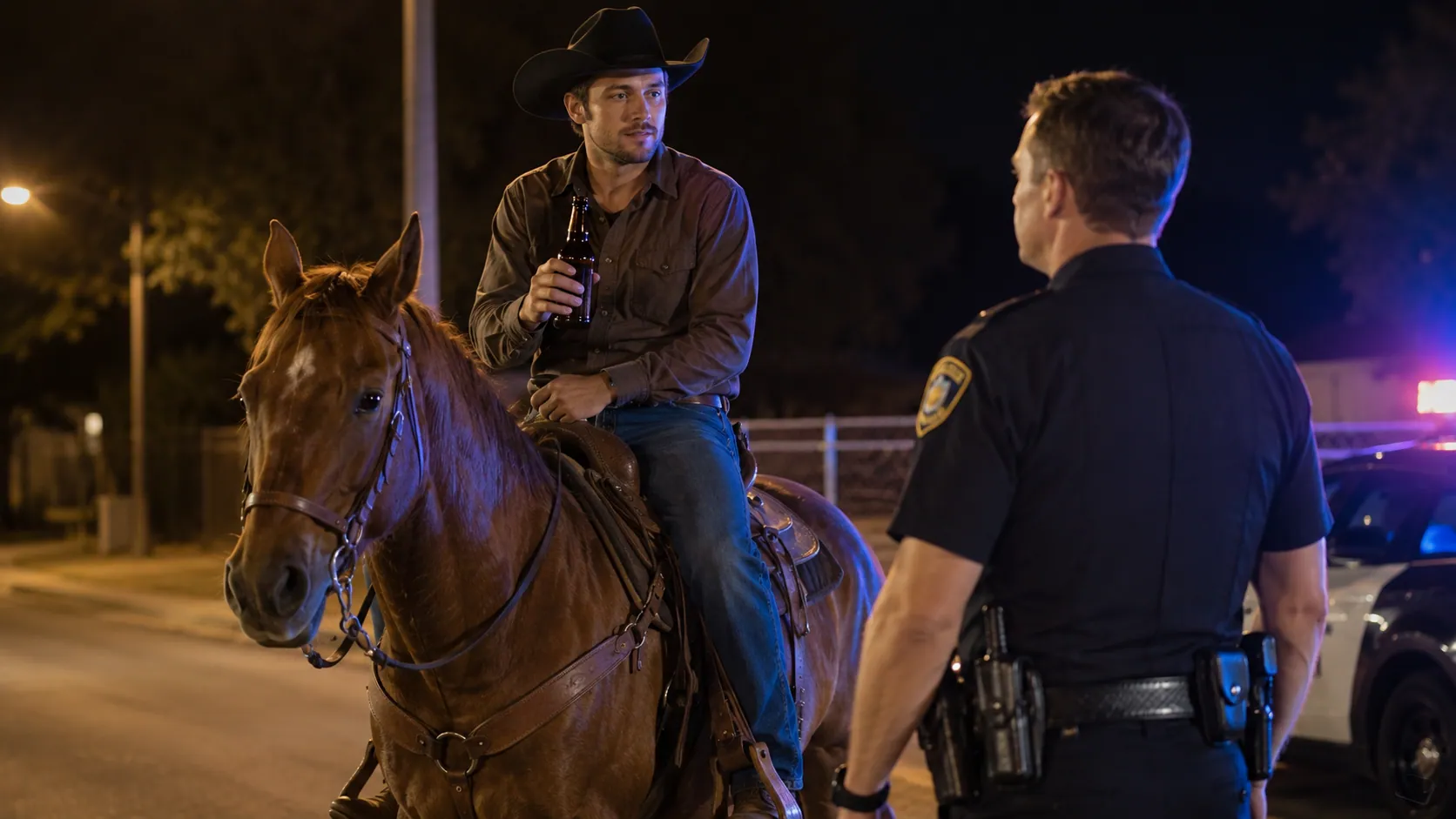
It sounds like a strange question, but it is a real legal issue in some places. The answer is not the same everywhere because horseback DUI laws depend on how each state defines a vehicle, a roadway, and impaired operation.
In many states, DUI laws are written for motor vehicles, such as cars, trucks, motorcycles, and other powered vehicles. Since a horse is not a motor vehicle, riding a horse drunk may not always lead to a traditional DUI charge. However, some states and local laws may treat drunk horseback riding on public roads differently, especially if the rider creates a safety risk, blocks traffic, damages property, or puts other people in danger.
This guide explains the legal difference between a DUI on a horse and a regular DUI in a car. It also covers the safety risks, possible charges you could face, and what may happen if police stop you while riding a horse drunk. Because laws can change and vary by state, this article is for general information only. If you are dealing with a real case, it is best to check your local law or speak with a licensed attorney in your area.
Can You Get a DUI on a Horse? The Short Answer
The short answer is: sometimes, depending on where you are and how the law defines “vehicle.”
In many states, standard DUI laws apply to motor vehicles. That usually means cars, trucks, motorcycles, mopeds, and other powered vehicles. Under that kind of law, a horse may not qualify as a vehicle, so a person may not be charged with a traditional DUI simply for riding a horse while drunk.
However, that does not mean drunk horseback riding is always legal or safe. Some states have broader traffic laws that may include non-motorized vehicles, animal-drawn vehicles, riders of animals, or people using public roads in a dangerous way. In those places, can you get a DUI riding a horse may have a different answer.
Even when a horse is not considered a vehicle for DUI purposes, an intoxicated rider can still face legal trouble. Possible charges may include public intoxication, disorderly conduct, reckless endangerment, animal cruelty, traffic violations, or local ordinance violations.
So, the key point is simple: “not a DUI” does not always mean “legal,” and it definitely does not mean “safe.” A horse is a living animal, not a safe replacement for a sober ride home.
Why Horse DUI Laws Depend on the State
Horse DUI laws depend on the state because every state writes its DUI and traffic laws differently. One state may define DUI as operating a motor vehicle while impaired. Another state may use broader words like vehicle, conveyance, road user, or rider of an animal. Those small wording differences can completely change how the law applies.
For example, if a law only applies to a motor vehicle, a person riding a horse may not fit the legal definition. But if a law includes people riding animals on public roads, or if it gives police power to stop anyone creating a roadway hazard, the rider may still be charged under a different law.
Location also matters. Riding a horse while drunk on private property may be treated differently from riding on a public road, near traffic, through a town, or during an event. Public roads create more risk because cars, pedestrians, cyclists, and other riders may be nearby.
A prosecutor may look at several facts before deciding what charge, if any, applies:
- Where the rider was located
- Whether the horse was on a public road
- Whether the rider was blocking traffic
- Whether anyone was injured or placed in danger
- Whether property was damaged
- Whether the rider could control the horse
- Whether the horse was neglected, stressed, or put at risk
This is why legal resources may give slightly different answers about horseback DUI laws. The real answer depends on the exact wording of the state law, local rules, court decisions, and the facts of the situation.
Is a Horse Legally Considered a Vehicle?
The key legal question is this: is a horse a vehicle under the specific law being used? That answer depends on the wording of the law in your state or local area.
In many places, a horse itself is not considered a motor vehicle. DUI laws often focus on cars, trucks, motorcycles, and other powered vehicles. Since a horse is a living animal and not a machine, riding one while impaired may not fit the standard definition of drunk driving.
However, the situation can change when a horse is pulling something, such as a buggy, wagon, cart, or carriage. In that case, the person may be controlling a vehicle-like conveyance, even though the horse provides the movement. This is why a horse drawn buggy DUI may be treated differently from simply sitting on a horse.
For example, some Ohio legal discussions commonly explain that riding a horse may not be treated as an OVI in the same way as driving a car. But controlling a horse-drawn buggy, cart, or similar non-motorized vehicle can raise different legal questions. The same idea may apply in other states, depending on how the law defines vehicle, operator, and roadway use.
The safest way to understand horseback riding law is to remember that definitions matter. A horse may not be a motor vehicle, but that does not automatically protect an intoxicated rider from every possible charge. Local traffic laws, public safety rules, animal welfare laws, and non motorized vehicle DUI rules may still apply.
DUI on a Horse vs. DUI in a Car
A DUI in a car vs horse situation is very different legally, but both can involve impaired judgment and public safety risks.
A car DUI is usually clearer because a car is a motor vehicle. Most DUI laws were written mainly for people operating cars, trucks, motorcycles, and other powered vehicles. If a driver is impaired behind the wheel, the legal path is usually direct: police may investigate, test for impairment, and file a DUI, DWI, or OVI charge.
A horse DUI is more complicated. A horse is a living animal, not a machine. It can react to traffic, noise, lights, dogs, people, or sudden movement. The rider also may not fit the legal definition of someone operating a motor vehicle. Because of that, drunk driving vs horseback riding is not always treated the same under the law.
Still, both situations can lead to police involvement. If someone is riding drunk on a public road, blocking traffic, falling off the horse, frightening pedestrians, or failing to control the animal, officers may decide the situation is unsafe. Even if the rider does not receive a standard horse DUI charge, they may still face public intoxication, disorderly conduct, reckless endangerment, animal cruelty, or other charges.
| Factor | DUI in a Car | DUI on a Horse |
| Vehicle type | Motor vehicle | Animal or animal-drawn transport |
| Law clarity | Usually clear | Depends on state law |
| Public safety risk | High | Still real |
| Possible charges | DUI, DWI, or OVI | DUI, public intoxication, disorderly conduct, animal cruelty, reckless endangerment |
| Location matters | Yes | Yes, often even more |
Courts and prosecutors may look closely at the facts. Was the rider on a public road? Were cars forced to stop or swerve? Did the horse enter traffic? Was anyone hurt? Did the rider lose control? These details can make a major difference in how the case is handled.
Where You Ride Matters: Public Roads, Private Property, and Events
Where you ride can make a big difference in how the law treats the situation. Horseback riding on public roads usually creates more legal risk than riding on private land because public streets involve traffic laws, pedestrians, drivers, cyclists, and general public safety concerns.
If someone is riding a horse drunk on a public road, police may see it as a danger even if the horse is not considered a motor vehicle under that state’s DUI law. The rider could block traffic, drift into a lane, fall into the road, or lose control of the horse near cars and people. In that situation, officers may focus less on the label “DUI” and more on whether the rider is creating a public safety risk.
Riding a horse drunk on private property may reduce the chance of a traditional DUI charge, especially if the rider is not near public traffic. However, private property does not remove every legal or safety concern. If someone gets hurt, property is damaged, a guest is injured, or the horse is mistreated, the rider may still face liability or other consequences.
Events can also have their own rules. Fairs, rodeos, parades, farms, public parks, trail systems, and organized riding events may follow separate policies. Some areas have specific trail riding laws, park rules, animal-control rules, or event safety requirements. Even if police do not file a DUI charge, event organizers may remove an intoxicated rider to protect guests, staff, other riders, and the horse.
In simple terms, location matters. A quiet pasture, a public street, a parade route, and a busy trail are not treated the same. The more public the setting, the more likely intoxicated riding can turn into a legal or safety problem.
Other Charges You Could Face Besides DUI
DUI is not the only possible legal issue. A person may avoid a formal DUI charge and still face fines, arrest, court involvement, or civil claims if their behavior puts others at risk.
Possible charges or consequences may include:
- Public intoxication if the rider is visibly drunk in a public place
- Disorderly conduct if the behavior causes a disturbance
- Reckless endangerment if the rider puts people, drivers, pedestrians, or the horse in danger
- Animal cruelty or neglect if the horse is harmed, overworked, abandoned, or placed in an unsafe situation
- Traffic violations if the rider blocks lanes, ignores road rules, or creates a hazard
- Open container violations if alcohol is carried or consumed in a restricted public area
- Trespassing if the rider enters private land without permission
- Civil liability if someone is injured or property is damaged
This is why public intoxication on a horse can still be serious. The law may punish the unsafe behavior, not just the “driving” label. For example, an intoxicated rider who cannot control the horse near traffic may face a reckless endangerment horse riding issue, even if the state does not treat the horse as a motor vehicle.
There is also the animal-welfare side. Animal cruelty drunk riding concerns may arise if the horse is forced into unsafe traffic, ridden in dangerous conditions, injured, neglected, or handled by someone too impaired to care for it properly. A horse depends on the rider for direction and protection. When the rider is drunk, the horse can become part of a dangerous situation through no fault of its own.
So, even when a person cannot be charged with DUI, they may still face other legal trouble. The safest rule is simple: if you are too impaired to drive, you are also too impaired to ride, lead, or manage a horse in public.
Real-World Examples of Drunk Horseback Riding Cases
Real-world horse DUI cases show why the answer is not always simple. The outcome often depends on the location, the exact wording of the law, and what the rider was doing at the time.
In some Georgia-related legal discussions, animal riders on roadways may have duties under traffic laws. That means a person riding a horse on a public road while impaired could potentially face legal exposure if the behavior fits the state’s rules and creates a roadway safety issue. This does not mean every drunk horseback rider in Georgia will automatically get a DUI, but it shows how public-road rules can matter.
North Carolina coverage has reported a different angle. There, a person generally may not get a DWI solely for riding a horse because the law focuses on vehicles or motor vehicles. However, that does not mean there are no consequences. Depending on the facts, the person could still face other charges, such as public intoxication, disorderly conduct, or animal-related concerns.
The issue is not limited to the United States. In the United Kingdom, there have been reports of people being prosecuted under older laws for being drunk in charge of a horse. That example shows that some places still have specific non-car intoxication laws that can apply to animals, carts, or public movement while impaired.
These real DUI horse examples are useful because they show one important point: the law does not treat every case the same. A horseback DWI case may turn on details such as whether the rider was on a public road, whether the horse was pulling a carriage, whether traffic was affected, and whether the rider created a danger to others.
The practical takeaway is not to rely on funny myths like “a horse can take you home.” Courts, police, and local officials usually care about safety, control, and public risk. If an impaired rider creates a dangerous situation, the legal system may still respond, even when the charge is not called DUI.
Why Riding a Horse Drunk Is Still Dangerous
A horse is not a safe “designated driver.” Even if the horse is calm, trained, or familiar with the route, the rider still needs clear judgment, steady balance, and quick reactions. Alcohol can reduce all of those abilities.
Drinking can affect coordination, reaction time, decision-making, and the ability to control the animal. A rider who is impaired may pull the reins too hard, give confusing signals, miss road hazards, or fail to notice when the horse becomes nervous. That can quickly turn a simple ride into a dangerous situation.
There are also real drunk horseback riding dangers for people nearby. A horse may spook, bolt, step into traffic, slip, fall, or injure a pedestrian. Loud cars, dogs, headlights, sirens, crowds, and uneven ground can all cause problems, especially when the rider is not alert enough to respond properly.
The rider can also be seriously hurt. Falling from a horse can cause head injuries, broken bones, spinal injuries, or other trauma. Alcohol makes this risk worse because it affects balance and slows the body’s natural response to danger.
The horse can be harmed too. An impaired rider may push the horse into unsafe areas, fail to notice signs of stress, or make poor choices around roads, weather, crowds, or footing. Good horse safety depends on calm handling, attention, and responsible control.
So, is it safe to ride a horse drunk? No. Even if a DUI charge does not apply, the impaired riding risks are still serious. Safe horseback riding requires alertness, balance, patience, and the ability to make quick decisions when something unexpected happens.
What Happens If Police Stop You on a Horse While Drunk?
If police stop a drunk horseback rider, what happens next depends on the location, the rider’s behavior, and local law. Officers will usually focus first on safety: the rider’s safety, the horse’s safety, and the safety of people nearby.
Police may ask questions such as where you are coming from, where you are going, whether you have been drinking, and whether someone sober can help. They may also look for signs of impairment, such as slurred speech, poor balance, confusion, aggressive behavior, or trouble controlling the horse.
In some cases, officers may remove the rider from the road or ask them to dismount if it is safe to do so. They may arrange a safe ride home, call a sober friend or family member, contact animal control, or find someone qualified to care for the horse. If the situation is more serious, police may issue citations or make an arrest.
A BAC test on a horse situation may sound unusual, but alcohol testing can still be used if officers suspect an offense that involves intoxication. Field sobriety tests, breath tests, or other checks may depend on the suspected charge and the law in that area.
If a police stop drunk horseback rider situation happens, the smartest response is to stay calm, avoid arguing, and follow lawful safety instructions. Do not make the situation worse by becoming loud, combative, or careless with the horse. If you are charged with a horse DUI arrest, public intoxication, disorderly conduct, or another offense, speak with a local attorney who understands DUI and traffic law in your state.
This is general information, not legal advice. The exact answer to what happens if you ride drunk depends on the facts of the case and the law where it happens.
Can You Lose Your Driver’s License for a DUI on a Horse?
Whether you can lose your license for DUI on a horse depends on state law and the exact charge. There is no single answer that applies everywhere.
If the case is treated as a DUI, DWI, or OVI under state law, driver’s license penalties may be possible. Some DUI laws connect impaired operation with license suspension, fines, court costs, probation, alcohol education, or other penalties. If a horse, carriage, buggy, or animal-drawn vehicle falls under the law in that state, the consequences may be more serious than people expect.
If the charge is not treated as DUI, license penalties may be less likely. For example, if the person is charged with public intoxication, disorderly conduct, trespassing, or a local ordinance violation, the case may not directly affect their driver’s license. However, that does not mean the situation is harmless. Fines, arrest records, court appearances, probation, community service, and criminal records can still create long-term problems.
Courts may also look at whether anyone was injured, whether property was damaged, whether the horse was mistreated, and whether the rider created a public safety hazard. These details can affect horse DUI penalties and other possible DWI consequences.
Because the law varies so much, anyone facing a real charge should speak with a local DUI attorney. A DUI attorney horse case may sound unusual, but it still requires careful legal review. The attorney can explain whether the charge fits the law, whether license penalties are possible, and what options may be available.
Does It Matter If the Horse Knows the Way Home?
People sometimes joke that a horse can find its own way home, but that does not make riding horse home drunk safe or legally risk-free. Even if the horse knows the way home drunk, the rider is still responsible for control, safety, and decision-making.
A familiar route can still become dangerous. A calm horse may react suddenly to cars, barking dogs, sirens, headlights, crowds, loose animals, potholes, slick pavement, or road debris. If the rider is impaired, they may not respond quickly enough to guide the horse, calm it down, or avoid a hazard.
This is why “the horse knew the way” is not a reliable legal defense. Police, courts, and local officials are usually more concerned with whether the rider created a public safety risk, failed to control the animal, blocked traffic, or put people and the horse in danger.
So, can a horse be a designated driver? Not really. A horse is a living animal, not a substitute for a sober person. The responsibility still belongs to the rider. Good drunk horse rider responsibility means knowing when not to ride at all.
Safer Alternatives After Drinking
The safest choice after drinking is to avoid riding, leading, or handling a horse in any risky public setting. Planning ahead protects you, your horse, and everyone nearby.
If you have been drinking, consider safer options such as:
- Call a sober friend or family member
- Use a rideshare, taxi, or other safe ride after drinking
- Stay overnight instead of trying to get home immediately
- Ask a sober horse handler to lead, trailer, or care for the horse
- Arrange transportation before drinking begins
- Avoid taking a horse onto roads at night, especially near traffic
Horse welfare matters too. Make sure the horse is safely tied, trailered, stabled, or handled by someone sober and experienced. An impaired person may not notice stress, injury, loose tack, unsafe footing, or traffic hazards.
The best rule is simple: if you would not trust yourself to drive a car, you should not trust yourself to manage a horse on a road, trail, or public route. A little planning can help you avoid drunk riding and keep both you and the horse safe.
Conclusion: Can You Get a DUI on a Horse?
Can you get a DUI on a horse? In some places, yes. In others, standard DUI law may not apply because a horse may not be considered a motor vehicle. But that does not mean riding drunk is legal, safe, or free from consequences.
The most important thing to remember is that state law controls the answer. Public roads create more legal risk because they involve traffic, pedestrians, and public safety. A horse may or may not count as a vehicle under local law, and a horse-drawn buggy can be treated differently from riding a horse by itself.
Even when a DUI on horseback does not apply, public intoxication, reckless behavior, disorderly conduct, traffic violations, animal welfare concerns, or civil liability may still lead to trouble. More importantly, drunk horseback riding can put the rider, the horse, drivers, pedestrians, and nearby property at risk.
The safest and smartest choice is simple: plan a sober ride, arrange help for the horse, and keep the animal out of a risky situation. Good safe riding advice always starts with clear judgment, responsible planning, and respect for both the law and the horse.
Quick FAQ About Getting a DUI on a Horse
Can you get a DUI on a horse in every state?
No. The answer depends on horse DUI state law. Some states write DUI laws around motor vehicles, while others may have broader rules for vehicles, public roads, animal riders, or unsafe public behavior.
Is riding a horse drunk legal if DUI does not apply?
Not necessarily. Even if standard DUI law does not apply, drunk horseback riding law may still involve other charges. A rider could face public intoxication, disorderly conduct, reckless endangerment, animal cruelty, traffic violations, or local ordinance violations.
Can you get a DUI on a horse on private property?
It is usually less likely than on a public road, but it is not impossible for legal problems to happen. State law, injuries, property damage, event rules, trespassing issues, or animal welfare concerns can still matter, even on private land.
Can you get a DUI in a horse-drawn buggy?
In some places, yes. A horse drawn buggy DUI may be treated differently from simply riding a horse because the person may be operating a cart, buggy, wagon, or carriage on a public road. The exact answer depends on how local law defines a vehicle or operator.
Is a horse a good alternative to driving drunk?
No. A horse is a living animal, not a safe substitute for a sober ride. Even a calm horse can spook, bolt, step into traffic, or become stressed. The safest choice is to avoid riding or handling a horse while impaired.
Disclaimer
This article is for general informational purposes only and should not be taken as legal advice. DUI laws, horseback riding rules, and legal outcomes can vary by state, location, and individual situation. For guidance about a specific case, always check local laws or speak with a qualified legal professional.