
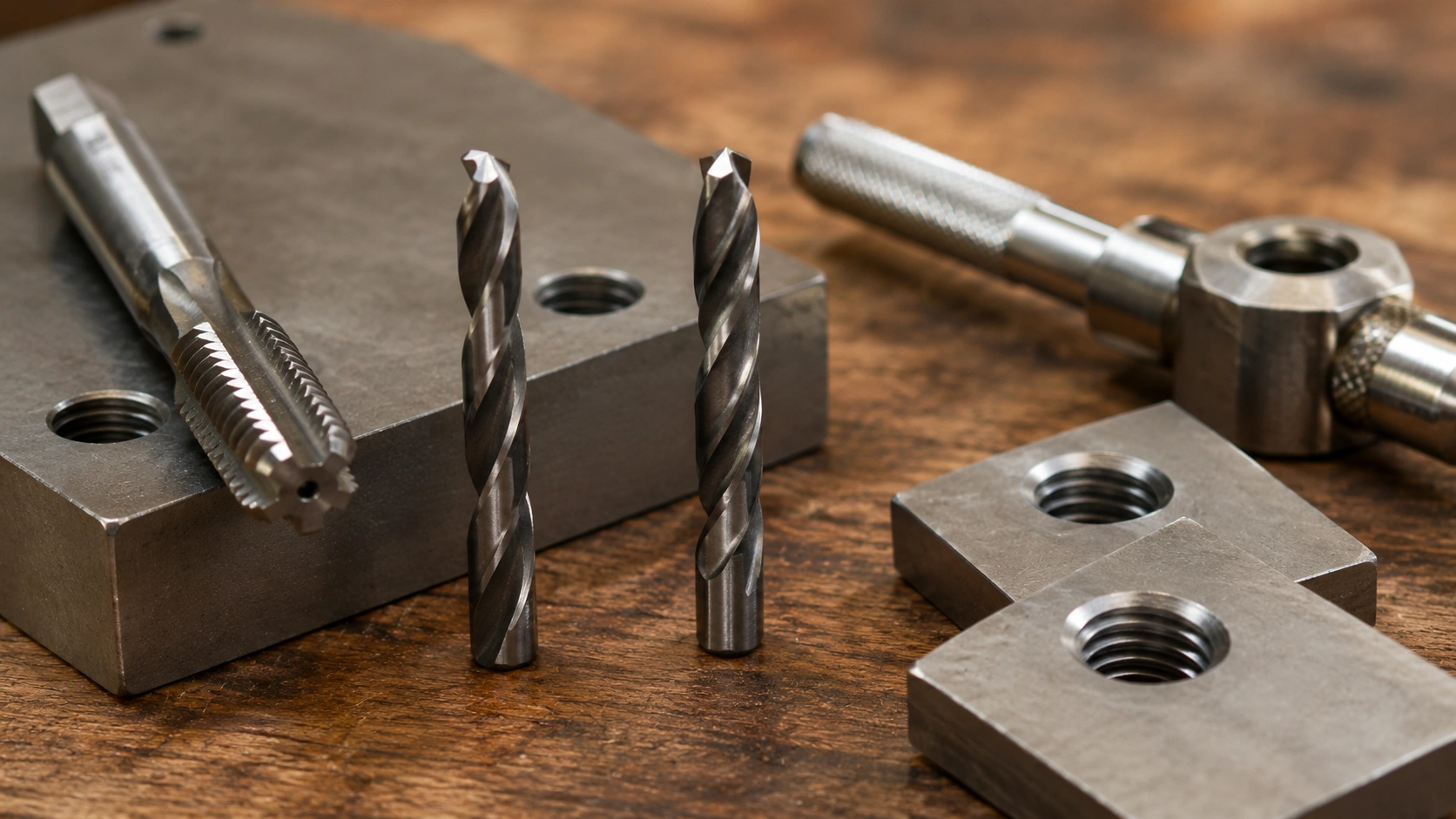
What is the drill size for a 3/8 tap is one of the most common questions people ask before cutting internal threads in metal, plastic, or other workshop materials. The quick answer is: for a 3/8-16 UNC tap, use a 5/16 drill bit, which equals 0.3125 inch or about 7.94 mm. For a 3/8-24 UNF tap, use a Letter Q drill bit, which equals about 0.3320 inch or roughly 8.43 mm.
The important detail is that a “3/8 tap” can mean more than one thread pitch. A 3/8-16 tap is the common coarse thread version, while a 3/8-24 tap is the fine thread version. They do not use the same tap drill size, so always check the numbers printed on the tap before drilling.
Quick Tap Drill Size Chart for a 3/8 Tap
The easiest way to choose the correct drill bit size for a 3/8 tap is to use a simple tap drill size chart. The chart below gives the two most common 3/8 tap sizes, their thread types, and the correct drill sizes.
| Tap Size | Thread Type | Threads Per Inch | Correct Drill Size | Decimal Size | Approx. Metric Size |
| 3/8-16 | UNC / Coarse thread | 16 TPI | 5/16 inch | 0.3125 in | 7.94 mm |
| 3/8-24 | UNF / Fine thread | 24 TPI | Letter Q | 0.3320 in | 8.43 mm |
For most general repair, fabrication, and DIY projects, the 3/8-16 tap drill size is the one people need because 3/8-16 UNC is the standard coarse-thread option. However, if your tap says 3/8-24, you need the Q drill bit, not the 5/16 drill bit.
A helpful shop rule is this: do not guess based only on the 3/8 diameter. The second number, such as 16 or 24, tells you the thread pitch, and that changes the required drilled hole size.
Why the Drill Size Changes for 3/8-16 and 3/8-24
A 3/8 tap does not always use one universal drill size because the tap’s thread pitch changes how much material must remain inside the hole. The first number, 3/8, refers to the nominal outside diameter of the matching bolt or screw thread. The second number tells you how many threads fit into one inch.
A 3/8-16 tap has 16 threads per inch. This is called UNC, or Unified National Coarse. Coarse threads have deeper thread forms and more space between each thread. Because of that, a 3/8-16 tap needs a smaller drilled hole, which is why the correct size is 5/16 inch.
A 3/8-24 tap has 24 threads per inch. This is called UNF, or Unified National Fine. Fine threads are closer together and shallower than coarse threads, so they need a slightly larger drilled hole. That is why the correct 3/8-24 tap drill size is Letter Q.
This difference matters because using the wrong drill size can create weak threads, stripped threads, or a broken tap. If you drill too small, the tap has to remove too much material and may bind. If you drill too large, the tap will not leave enough thread engagement for a strong fastener connection.
Drill Size for a 3/8-16 Tap
The correct drill size for a 3/8-16 tap is 5/16 inch. This is the standard size used for cutting 3/8-16 UNC internal threads.
A 5/16 drill bit measures 0.3125 inch, which is about 7.94 mm. In many basic tap drill charts, this may be rounded close to 8 mm, but the standard fractional size is still 5/16 inch.
Use this size when the tap is marked:
3/8-16
3/8-16 UNC
3/8 NC
3/8 coarse thread
This size is common in steel, aluminum, brass, and many general workshop jobs. It is also common in automotive repair, brackets, fixtures, equipment maintenance, and machinery work.
The reason a 5/16 tapping hole works is that it leaves enough material for the tap to cut the internal thread profile. If you used a 3/8 drill bit instead, the hole would already be near the finished bolt diameter, leaving little or no material for the tap to cut.
So, if your main question is what size drill bit for 3/8-16 tap, the answer is simple: use a 5/16 drill bit.
Drill Size for a 3/8-24 Tap
The correct drill size for a 3/8-24 tap is a Letter Q drill bit. A Q drill bit measures about 0.3320 inch, or roughly 8.43 mm.
Use this size when the tap is marked:
3/8-24
3/8-24 UNF
3/8 NF
3/8 fine thread
A 3/8-24 tap cuts 24 threads per inch, so it is a fine thread tap. Fine threads are often used where a tighter adjustment, better clamping control, or stronger resistance to vibration may be useful. They are also common in some automotive, machinery, and precision applications.
Because the 3/8-24 UNF thread has more threads per inch than 3/8-16 UNC, the hole size is different. The Letter Q drill is larger than 5/16 inch, but still smaller than the final 3/8 thread diameter.
If you do not have a Letter Q bit, do not automatically grab the closest random drill bit. A hole that is even slightly too large can reduce thread strength. For important or load-bearing work, use the correct Q drill size or check a reliable tap drill chart before drilling.
Tap Drill Size vs Clearance Hole Size
One common mistake is confusing a tap drill size with a clearance hole size. These are not the same thing.
A tap drill hole is the hole you drill before using a tap to cut threads. It must be smaller than the finished thread size because the tap needs material to cut. For example, a 3/8-16 tap uses a 5/16 drill bit, not a 3/8 drill bit.
A clearance hole, on the other hand, is a hole that lets a bolt pass through without threading into the material. A clearance hole for a 3/8 bolt is larger than the bolt’s outside diameter, so the bolt can slide through easily.
| Hole Type | Purpose | Example for 3/8 Fastener |
| Tap drill hole | Leaves material for cutting internal threads | 5/16 for 3/8-16 |
| Clearance hole | Lets a bolt pass through freely | Larger than 3/8 inch |
| Close fit | Gives tighter bolt alignment | Used where positioning matters |
| Free fit | Allows easier assembly | Used for general fastening |
This distinction is important. If you use a clearance hole chart when you actually need a tapping hole, the drilled hole will be too large and the threads may not hold properly.
How Tap Drill Size Is Calculated
A basic way to understand tap drill size calculation is this formula:
Major thread diameter minus thread pitch = approximate tap drill size
For inch threads, the pitch can be found by dividing 1 by the threads per inch. For example, 3/8-16 has 16 TPI, while 3/8-24 has 24 TPI.
This formula helps explain why the drill size changes, but most users should still follow a standard tap drill size chart. Charts are easier, faster, and safer because they account for common shop practice and practical thread engagement.
Many tap drill charts are based around approximately 75% thread. This means the thread is strong enough for most normal applications without making tapping unnecessarily difficult. A very high thread percentage may sound stronger, but it can make the tap harder to turn and increase the risk of breakage, especially in steel or stainless steel.
For everyday work, the best approach is simple: use 5/16 inch for 3/8-16 and Letter Q for 3/8-24.
Metric and Decimal Conversions for 3/8 Tap Drill Sizes
Metric and decimal conversions are useful if your drill index does not use fractional or letter sizes. Here are the key conversions for a 3/8 tap drill size:
| Tap Size | Standard Drill Size | Decimal Equivalent | Metric Equivalent |
| 3/8-16 UNC | 5/16 inch | 0.3125 inch | 7.94 mm |
| 3/8-24 UNF | Letter Q | 0.3320 inch | 8.43 mm |
Some metric charts may show 8 mm for 3/8-16 UNC and 8.5 mm for 3/8-24 UNF. These are close metric equivalents, but if you have the exact fractional or letter drill bit, use the standard size.
For non-critical work, a close metric drill may sometimes be acceptable. However, for a clean threaded hole, strong thread engagement, or mechanical parts under stress, it is better to use the recommended drill size instead of a rough substitute.
How to Drill and Tap a 3/8 Hole
Drilling and tapping a 3/8 threaded hole is not difficult, but accuracy matters. A small mistake can lead to crooked threads, a broken tap, or a hole that cannot hold a bolt properly.
Start by confirming the tap size. If the tap says 3/8-16, choose a 5/16 drill bit. If it says 3/8-24, choose a Letter Q drill bit. Do not drill until you know whether the tap is UNC coarse thread or UNF fine thread.
Mark the hole location clearly, then use a center punch to keep the drill bit from wandering. Drill the hole straight and steady. If the material is thick or hard, a smaller pilot hole may help guide the final drill bit.
After drilling, apply cutting oil or tapping fluid, especially when working with steel or stainless steel. Place the tap in a tap wrench or T-handle tap wrench and start it as square as possible to the hole. A crooked start can damage the threads and make the bolt sit at an angle.
Turn the tap slowly. A common method is to turn forward slightly, then back up a little to break chips. This helps with chip evacuation and reduces the risk of binding. Continue until you reach the needed thread depth.
After tapping, back the tap out carefully, clean the hole, remove chips, and test the bolt by hand. The bolt should thread in smoothly without excessive force.
Material Tips for Tapping a 3/8 Hole
The correct tap drill size does not usually change by material, but your drilling and tapping technique should.
For steel, use cutting oil, steady pressure, and a sharp drill bit. Steel can create more resistance than softer materials, so do not rush the tap.
For stainless steel, go slower and use a good lubricant. Stainless can work-harden if overheated or rubbed too much, which makes tapping more difficult. A sharp HSS drill bit or cobalt drill bit is often helpful.
For aluminum, tapping is usually easier, but aluminum can gall or stick to cutting edges. Use a suitable tapping fluid and clear chips often.
For brass, the work is usually smoother, but you still need to keep the tap straight and avoid forcing it. For plastic, be careful not to oversize the hole or damage the thread shape.
For sheet metal, a normal tapped hole may not have enough thread depth. In that case, a threaded insert, rivnut, or other fastening method may be stronger than tapping directly into thin material.
Common Mistakes When Choosing a 3/8 Tap Drill Size
The biggest mistake is using a 3/8 drill bit for a 3/8 tap. This makes the hole too large for proper internal threads. Remember, the tap cuts the final thread shape, so the drilled hole must be smaller than the finished thread diameter.
Another common mistake is not checking whether the tap is 3/8-16 or 3/8-24. These two taps look similar at first glance, but they use different drill sizes. A 3/8-16 tap needs 5/16 inch, while a 3/8-24 tap needs Letter Q.
Drilling too small can also cause problems. If the hole is undersized, the tap has to remove too much material. This can make the tap bind, twist, or break. A broken tap is difficult to remove because taps are hard and brittle.
Drilling too large creates the opposite problem. The tap may still cut something, but the threads can be shallow, weak, or easy to strip. This is especially risky in load-bearing parts.
Other common mistakes include tapping without cutting oil, starting the tap crooked, using a drill instead of a tap wrench for hand tapping, and failing to back the tap out to clear chips.
Tools You May Need for Drilling and Tapping
For a clean 3/8 tapped hole, you need the right tools, not just the right drill size. At minimum, you need the correct tap, the correct drill bit, and a tap wrench.
For a 3/8-16 tap, use a 5/16 drill bit. For a 3/8-24 tap, use a Letter Q drill bit. A quality high-speed steel drill bit is fine for many general jobs, while a cobalt drill bit may be better for harder metals such as stainless steel.
A tap and die set can be useful if you work with different thread sizes often. You may also need cutting oil, a center punch, a drill press or hand drill, a tap wrench, and a thread pitch gauge.
For blind holes, a plug tap or bottoming tap may be needed to cut threads closer to the bottom. For through holes, a taper or plug tap is usually easier to start.
FAQs About 3/8 Tap Drill Size
What size drill bit do I need for a 3/8-16 tap?
For a 3/8-16 tap, use a 5/16 drill bit. The decimal equivalent is 0.3125 inch, and the metric equivalent is about 7.94 mm.
What size drill bit do I need for a 3/8-24 tap?
For a 3/8-24 tap, use a Letter Q drill bit. The decimal equivalent is about 0.3320 inch, or roughly 8.43 mm.
Can I use a 3/8 drill bit for a 3/8 tap?
No. A 3/8 drill bit is too large for tapping a 3/8 internal thread. The hole must be smaller so the tap can cut threads into the material.
What is the difference between 3/8-16 and 3/8-24?
3/8-16 has 16 threads per inch and is a UNC coarse thread. 3/8-24 has 24 threads per inch and is a UNF fine thread. They require different tap drill sizes.
What happens if the tap drill hole is too large?
If the hole is too large, the tap may create shallow threads. This can lead to weak threads, poor bolt grip, or stripped threads.
What happens if the tap drill hole is too small?
If the hole is too small, the tap has to cut too much material. This can make the tap hard to turn and may cause it to break inside the hole.
What if I drilled the wrong size hole?
If the hole is too small, you may be able to redrill it to the correct size. If the hole is too large, the threads may be weak. For important parts, you may need a threaded insert, thread repair kit, or a new hole location.
Final Answer
The best drill size for a 3/8 tap depends on the thread pitch. For a 3/8-16 UNC tap, use a 5/16 drill bit, which equals 0.3125 inch or about 7.94 mm. For a 3/8-24 UNF tap, use a Letter Q drill bit, which equals about 0.3320 inch or roughly 8.43 mm.
Always check whether your tap is 3/8-16 coarse thread or 3/8-24 fine thread before drilling. Do not use a 3/8 drill bit for a tapped 3/8 hole because it will be too large to cut strong internal threads. For the best result, drill straight, use cutting oil, keep the tap aligned, and back it out regularly to clear chips.
Disclaimer: This article is for general workshop and technical information only. Results may vary based on tools, materials, and user skill level. Always follow proper safety practices and manufacturer guidelines when drilling and tapping.