
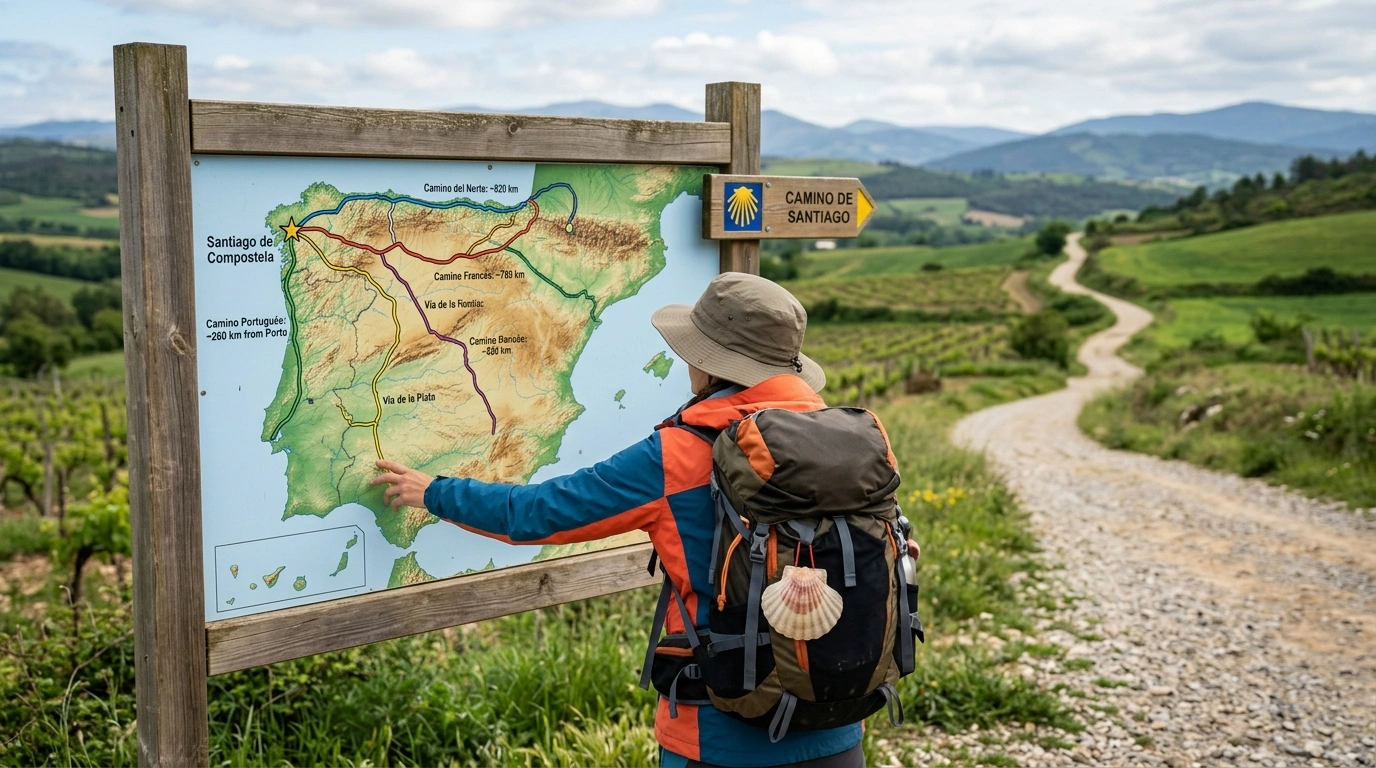
The honest answer is that it depends on which Camino route you choose, where you start, how many kilometres you walk per day, and whether you want to complete the full pilgrimage or only the minimum distance needed for the Compostela. For many travelers, the full Camino Francés from Saint-Jean-Pied-de-Port to Santiago de Compostela is about 790 km (490 miles) and often takes around 30 to 40 days. But plenty of pilgrims choose a much shorter option, such as walking the last 100 km from Sarria, which usually takes about 5 to 7 days. Official Camino rules also state that to receive the Compostela certificate, pilgrims must complete at least the last 100 km on foot or horseback, or 200 km by bicycle, on an approved route.
What makes this topic so confusing is that the Camino de Santiago is not one single trail. It is a network of pilgrimage routes, also known as the Way of Saint James, all leading to Santiago de Compostela. That is why one person may say the Camino is about 112.5 km, while another says it is 800 km or more. They may both be right.
Quick Answer: Camino Distance and Time at a Glance
Before getting into details, here is the simplest way to understand Camino de Santiago length.
| Route / Starting Point | Approx. Distance | Typical Time | Best For |
| Sarria to Santiago | 100–115 km | 5–7 days | Short trip, Compostela goal |
| English Way from Ferrol | 112.5 km | 5–6 days | One-week Camino |
| Portuguese Way from Porto | ~240 km | 10–14 days | Moderate-length first Camino |
| Camino Primitivo | ~320 km | 12–16 days | Experienced walkers |
| Camino del Norte | ~817 km | 4–6 weeks | Scenic, longer pilgrimage |
| Full Camino Francés | ~790 km | 30–40 days | Classic full Camino |
| Via de la Plata | 1,000 km+ | 6–8 weeks | Long-distance pilgrims |
The exact number varies by guide, detours, stage planning, and where you begin or end each day, but this table matches the range most searchers are really asking about when they type “how long does the Camino take” or “how long is each Camino route.”
Why There Isn’t One Single Camino Length
A lot of people expect a single number, like asking the length of one highway. But the Camino de Santiago works differently. It is a family of routes with different landscapes, histories, and starting points. The Camino Francés is the best-known route, so many articles use it as the default answer. The Portuguese Way, English Way, Camino del Norte, Camino Primitivo, and Via de la Plata are all valid answers too.
Your final duration also depends on pace. Some pilgrims walk around 20 to 25 kilometres per day, while others do less because of blisters, weather, steep terrain, or a desire to enjoy the towns, cafés, and historic sites along the way. Others move faster and finish shorter sections in fewer days. So when people ask “how many days does it take to walk the Camino?”, they are really asking a second question too: “What kind of Camino experience do I want?”
How Long Are the Most Popular Camino Routes?
The easiest way to answer how long is the Camino de Santiago pilgrimage is to break it down by route.
Camino Francés: The Classic Full Camino
The Camino Francés, or French Way, is the route most people imagine when they picture the Camino. It starts in Saint-Jean-Pied-de-Port in France and runs to Santiago de Compostela. Most reputable route guides place it at roughly 790 km, or about 490 miles, and many pilgrims complete it in around five weeks, though some take a little less and others take more.
This is the route with the strongest classic identity: Pyrenees crossings, famous stops such as Pamplona, Burgos, and León, and a well-developed pilgrim infrastructure with many albergues and services. If someone asks “how long does it take to walk the entire Camino Frances?”, 30 to 40 days is a realistic answer for most walkers. That makes it ideal for people who want the full historic pilgrimage and have the time for it.
Sarria to Santiago: The Popular Last 100 km
If your goal is the Compostela certificate and you have limited vacation time, Sarria is one of the most common starting points. That is because it allows you to cover the minimum 100 km on foot needed for the Compostela. In practice, this route is often a little over 100 km depending on the exact staging, and many pilgrims complete it in 5 to 7 days. Official Compostela guidance explains the minimum-distance rule, which is why this section is so popular.
This route works well for beginners because it offers a real Camino experience without requiring a month off work. It is also one of the best answers to search queries like “best Camino route for one week” or “how long is the last 100 km of the Camino.”
Portuguese Way: Porto and Lisbon Options
The Portuguese Camino gives pilgrims more than one practical distance option. Starting from Porto usually creates a moderate-length trip of around 240 km, which many walkers finish in roughly 10 to 14 days. Starting from Lisbon turns it into a much longer journey, often over 600 km. The Portuguese Coastal Way is another popular variation for people who want sea views and a slightly different feel from the inland route.
For first-time pilgrims, Porto to Santiago is often a sweet spot. It is long enough to feel like a major journey, but short enough for people who cannot spare five full weeks. That is why it shows up so often in real-world planning discussions and route comparisons.
English Way: One of the Shortest Official Options
The English Way is one of the most useful answers for anyone searching “shortest Camino route” or “how long does the English Way take.” According to Galicia’s official Camino site, the route from Ferrol is 112.5 km, while the route from A Coruña is 73 km and therefore does not meet the standard walking requirement for the Compostela on its own. For many pilgrims, the Ferrol start is the key number to know.
Because it is just above the minimum qualifying distance, the English Way from Ferrol is a very attractive one-week route. Many walkers complete it in about 5 to 6 days, depending on stage planning and pace. It is one of the strongest options for beginners who want an official route, a shorter timeframe, and a clear finish in Santiago de Compostela.
Camino del Norte, Primitivo, and Via de la Plata
The Camino del Norte is often placed around 817 km, making it a long pilgrimage that usually requires 4 to 6 weeks. It is famous for its coastal scenery and tends to appeal to people who want a longer, quieter route than the busiest sections of the Camino Francés. The Camino Primitivo, often listed around 320 km, is shorter but usually considered more physically demanding because of its terrain. The Via de la Plata is the heavyweight of the group, stretching to 1,000 km or more, often requiring 6 to 8 weeks.
These routes are important because they show why the keyword “how many miles is the Camino de Santiago” cannot have one universal answer. It depends entirely on which Camino you mean.
How Many Days Does the Camino Take?
Distance is only half the story. Most people also want to know how long does the Camino take in real life. A common daily pace is around 20–25 kilometres per day, though some pilgrims prefer shorter stages and others go farther. At that pace, a route of 100–115 km often becomes a 5–7 day walk, while a route of roughly 790 km becomes a month-long pilgrimage.
But daily pace is not just about fitness. Weather can slow you down. A steep day in the mountains can feel much longer than a flatter day of the same distance. Some pilgrims also add rest days, sightseeing time, or detours to monasteries, beaches, cathedrals, and village cafés. That is why two people walking the same route may report very different overall trip lengths.
A useful rule of thumb looks like this:
5–7 days for a minimum-distance Camino, 10–14 days for a medium route such as Porto to Santiago, 30–40 days for the full Camino Francés, and 6–8 weeks for very long routes such as the Via de la Plata.
How Far Do You Need to Walk for the Compostela?
This is one of the most important parts of the topic, and many articles blur it with the question of total Camino length. Official guidance from the Pilgrim’s Reception Office is clear: to receive the Compostela, you must complete at least the last 100 km on foot or horseback, or the last 200 km by bicycle, on a route officially recognized by the Cathedral of Santiago.
You also need the Credencial del Peregrino, and for the last 100 km on foot, the office says it is essential to collect at least two sellos per day. That detail matters, especially for people walking only the minimum qualifying distance. If you complete the Camino in stages over time, the Pilgrim’s Office says that is allowed, as long as the stages are done in chronological and geographical order and the credential clearly shows where you resumed the route.
This is why routes like Sarria to Santiago and Ferrol to Santiago are so popular. They are practical, time-efficient, and compatible with the official Compostela rules.
Best Camino Route by Time Available
For many readers, the real question is not “how long is the Camino?” but “what Camino can I realistically do with the time I have?”
If you have about 5 to 7 days, the best options are usually Sarria to Santiago or the English Way from Ferrol. Both give you a proper Camino experience and align well with the minimum Compostela distance. If you have 10 to 14 days, the Portuguese Way from Porto is one of the most balanced choices. It offers a fuller journey without demanding a month off work. If you have 3 to 5 weeks, the Camino Francés becomes realistic and gives you the classic long-form pilgrimage experience. And if you want a major endurance journey, routes like the Via de la Plata are for pilgrims who can dedicate far more time.
That time-based approach is often more useful than comparing routes only by kilometres, because most people plan around work, holidays, and family responsibilities.
Which Camino Is Best for Beginners?
There is no single best beginner route for everyone, but a few stand out. Sarria to Santiago is a strong first option for someone who wants a short, popular, well-supported Camino. The English Way from Ferrol is another excellent beginner choice because it is short, official, and straightforward in terms of timeframe. The Portuguese Way from Porto suits beginners who want more immersion and can spend around two weeks walking. The Camino Francés is also beginner-friendly in another sense: although it is much longer, it has some of the best infrastructure and is the classic route many people choose for a first full pilgrimage.
A simple way to choose is to match the route to your time, fitness, and goal. If your goal is the Compostela with limited time, pick a short qualifying route. If your goal is a life-changing long walk, the Camino Francés may be worth the extra weeks.
Factors That Change How Long the Camino Feels
Even when two routes have the same distance, they do not always feel equally long. Terrain changes everything. A mountainous stage can slow you down far more than a flatter one. Weather matters too. Official guidance reminds pilgrims not to treat the Camino like a pure sporting event and to allow time to rest, enjoy the scenery, and care for their bodies.
Foot care is another huge factor. The Camino can become much harder because of blisters, poorly fitted shoes, or carrying too much weight. Many pilgrims discover that the difference between a good day and a terrible day is not motivation but recovery, hydration, and proper footwear. That is why the Camino is best planned as a flexible journey rather than a rigid mileage challenge.
Best Time of Year to Walk the Camino
The best season depends on the route and your preferences, but spring and early autumn are often appealing because they balance daylight, weather, and crowd levels. Summer is very popular, but it can bring more heat and busier services on the most famous routes. Winter is quieter and can be beautiful, but shorter days and more difficult conditions can make stages slower and harder.
This matters for the keyword “how long is the Camino de Santiago” because the same route may take more effort in one season than another. A one-week Camino in mild weather is very different from a one-week Camino during heavy heat or winter rain.
Can You Walk the Camino in Sections?
Yes, and this is an important point for people with jobs or family commitments. Official Compostela guidance says the Camino can be completed in stages, as long as those stages are done in chronological and geographical order and the pilgrim’s record shows continuity.
That means you do not have to walk the full Camino Francés in a single month if life does not allow it. Some pilgrims complete a long route over several trips, returning to the exact point where they stopped. This makes the Camino far more accessible than many first-time walkers realize.
A Simple Case Study: Matching the Route to the Walker
Imagine three different pilgrims. One has six days off work and mainly wants the Compostela. That person will probably get the best result from Sarria or Ferrol. Another has two weeks and wants a longer, more varied experience. Porto to Santiago is likely the best fit. A third has five weeks, wants the classic route, and values the tradition of the pilgrimage itself. That person is an ideal match for the Camino Francés.
This is the real secret behind planning the Camino well: do not ask only “how long is the Camino?” Ask “which Camino length matches my life right now?”
The Camino is not only about covering kilometres, as if it were a sporting event; you must take time to rest, enjoy the scenery, talk to other pilgrims, or even to the people in the towns or cities you pass through.
That perspective captures the heart of the pilgrimage better than any mileage figure.
FAQ
Is the Camino really 500 miles long?
Sometimes. The full Camino Francés is commonly described as about 790 km, or roughly 490–500 miles. But not every Camino route is that long.
What is the shortest Camino route?
Among well-known official options that meet the normal Compostela walking rule, the English Way from Ferrol at 112.5 km is one of the shortest.
How long does Sarria to Santiago take?
Usually about 5 to 7 days, depending on your pace and stage plan. It is popular because it satisfies the 100 km Compostela requirement on foot.
Can beginners walk the Camino?
Yes. Many beginners choose Sarria, Ferrol, or Porto because those options are more manageable in time and planning.
Can you get the Compostela without walking the full Camino?
Yes. You only need the last 100 km on foot or 200 km by bicycle, provided you meet the official credential rules.
So, How Long Is the Camino de Santiago?
The best final answer is this: the Camino de Santiago can be as short as about 100 km or as long as 1,000 km or more, depending on the route you choose. For most readers, the two most useful reference points are the last 100 km for the Compostela and the full Camino Francés at roughly 790 km, which usually takes about 30 to 40 days. The right route is the one that fits your time available, walking ability, and reason for going.
So if you are asking “how long is the Camino de Santiago?”, the smartest answer is not one number. It is this: choose the Camino that matches your goal, and the right length will become obvious.
Disclaimer: This article is for general travel information only. Distances, time, and routes may vary based on personal pace, weather, and planning. Always check official Camino guidelines and plan according to your own fitness and travel needs.