
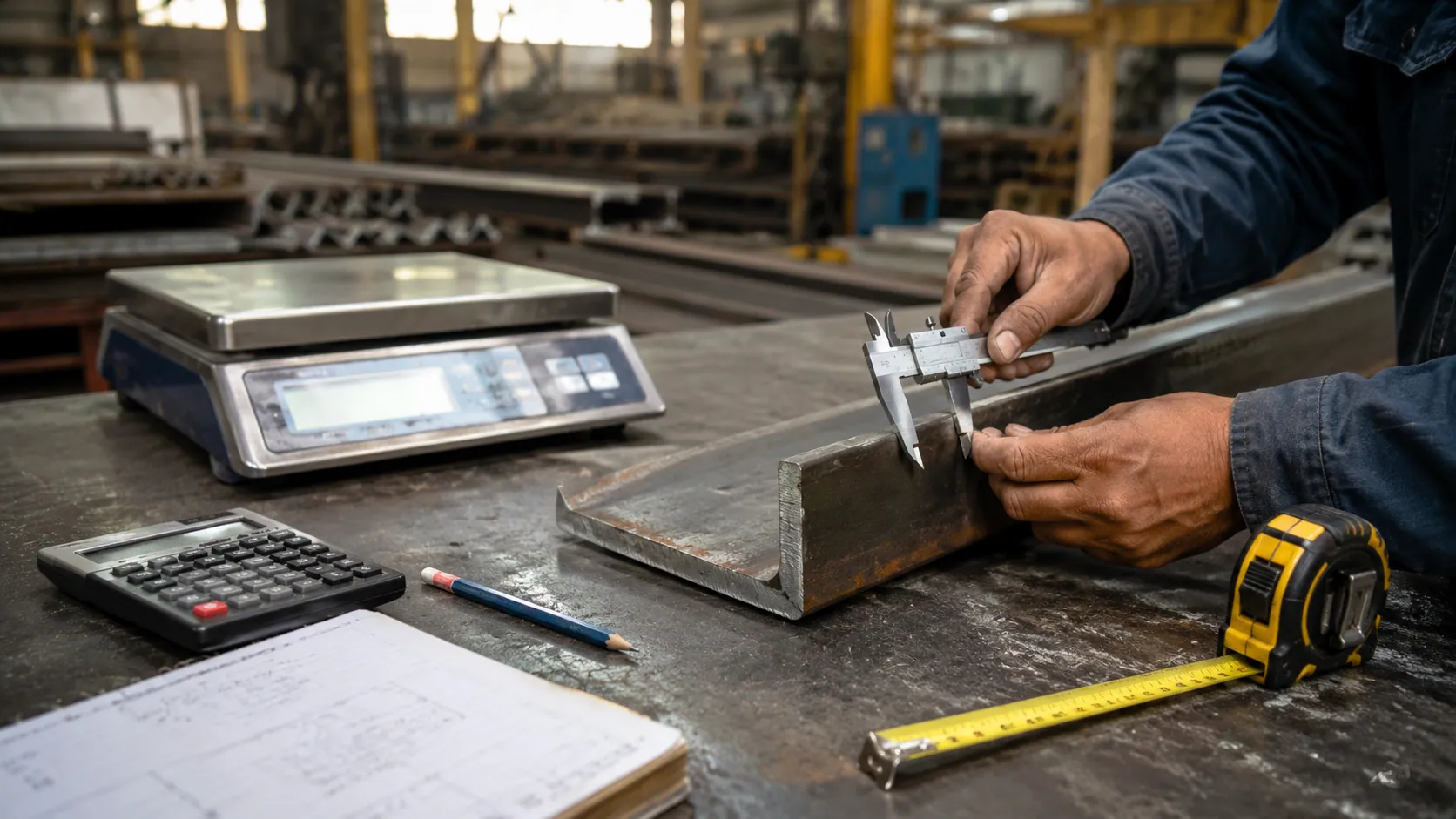
How to calculate the weight of angle is a common question in steel fabrication, construction, and material estimation. In this context, “angle” usually means a steel angle, MS angle, angle iron, L angle, angle bar, equal angle, or unequal angle. These L-shaped steel sections are widely used in building work, fabrication shops, industrial frames, and many small or large metal projects.
Knowing the correct angle weight calculation is important because steel is often purchased, transported, and billed by weight. If you know the approximate steel angle weight before ordering, you can estimate material cost more accurately, plan structural work better, manage transport and loading safely, check billing by kg or ton, and reduce fabrication waste. Even a small error in MS angle weight can become costly when the project needs many meters of steel.
This guide explains the angle iron weight formula in a simple way. You will learn how to calculate weight in kg/m, how equal and unequal angles are different, which density value is commonly used for mild steel, how to use a weight chart, and which common mistakes to avoid when finding the weight of angle bar for a project.
What Is an Angle in Steel and Fabrication?
A steel angle is an L-shaped metal section made with two legs joined at a 90-degree angle. Because of this shape, it offers good strength and support while still being easy to cut, weld, drill, and install. In everyday fabrication and construction language, it may be called an MS angle, steel angle, angle iron, L angle, or angle bar.
Steel angles are used in many practical applications, including frames, brackets, racks, supports, gates, trusses, machinery bases, and construction reinforcement. Fabricators often use them because they are simple, strong, and available in many sizes and thicknesses.
There are two common types of angles:
Equal angle: both legs are the same size, such as 50 × 50 × 5 mm.
Unequal angle: one leg is longer than the other, such as 75 × 50 × 6 mm.
For small workshop jobs, a quick formula may be enough to estimate the weight. However, for professional fabrication, structural work, or bulk purchasing, engineers and fabricators usually verify the calculated weight with standard steel tables, supplier charts, or project specifications before ordering. This helps avoid mistakes in cost estimation, load planning, and material quantity.
Basic Formula to Calculate the Weight of Angle
The basic angle weight formula is based on a simple engineering principle:
Weight = Cross-sectional area × Length × Density
In easy words, you first find how much steel is present in the cross-section of the angle. Then you multiply that area by the length and the density of the material. For mild steel, the commonly used density is:
Density of mild steel = 7850 kg/m³
For practical steel calculations where dimensions are measured in millimeters, fabricators often use the conversion factor:
0.00785
This helps convert the calculated area into kg per meter. Most steel calculators, supplier charts, and engineering references follow the same idea: calculate the angle’s area first, then multiply it by the steel density.
For an equal MS angle, the simplified formula is:
Weight per meter = [2 × A × t − t²] × 0.00785
Where:
A = leg size in mm
t = thickness in mm
0.00785 = steel density conversion factor
Final answer = kg/m
The reason we subtract t² is simple. A steel angle has two legs joined at the corner. If we calculate both legs separately as A × t + A × t, the corner area gets counted twice. Subtracting t² removes that double-counted overlap and gives a more accurate cross-sectional area.
Some online tools use shorter or simplified formulas for quick estimates, and those can be helpful for rough planning. However, the cross-sectional area method is cleaner, easier to understand, and more technically accurate for calculating steel angle weight, MS angle weight, and angle weight per meter.
How to Calculate Equal Angle Weight Step by Step
An equal angle has both legs of the same size. For example, if the size is written as:
50 × 50 × 5 mm
It means:
First 50 = one leg of the angle
Second 50 = the other leg of the angle
5 = thickness of the angle
To calculate equal angle weight, follow these steps:
- Identify the leg size.
- Identify the thickness.
- Calculate the cross-sectional area.
- Multiply the area by the steel density factor.
- Multiply by total length if you need the full weight.
Let’s calculate the weight of a 50 × 50 × 5 mm steel angle.
Formula:
Area = 2 × A × t − t²
Now place the values:
Area = 2 × 50 × 5 − 5²
Area = 500 − 25
Area = 475 mm²
Now multiply the area by the density conversion factor:
Weight per meter = 475 × 0.00785
Weight per meter = 3.73 kg/m approx.
So, the approximate 50x50x5 angle weight is:
3.73 kg per meter
If the angle length is 6 meters, then:
Total weight = 3.73 × 6
Total weight = 22.38 kg approx.
This means one 6-meter length of 50 × 50 × 5 mm MS angle weighs about 22.38 kg.
When preparing a quotation, always round carefully. A small difference of a few grams per meter may not matter for one piece, but it can make a noticeable difference in bulk orders, large fabrication jobs, transport planning, and billing by weight.
How to Calculate Unequal Angle Weight
An unequal angle has two legs of different sizes. Its size is usually written in this format:
75 × 50 × 6 mm
This means:
75 = longer leg
50 = shorter leg
6 = thickness
The unequal angle formula is slightly different from the equal angle formula because both legs are not the same size.
Weight per meter = [(A + B − t) × t] × 0.00785
Where:
A = longer leg in mm
B = shorter leg in mm
t = thickness in mm
0.00785 = steel density conversion factor
Let’s calculate the 75x50x6 angle weight.
Formula:
Area = (A + B − t) × t
Now place the values:
Area = (75 + 50 − 6) × 6
Area = 119 × 6
Area = 714 mm²
Now multiply the area by the steel density factor:
Weight per meter = 714 × 0.00785
Weight per meter = 5.60 kg/m approx.
So, a 75 × 50 × 6 mm unequal steel angle bar weighs about:
5.60 kg per meter
If the angle length is 6 meters, then:
Total weight = 5.60 × 6
Total weight = 33.60 kg approx.
Unequal angles are often used where the load, available space, or connection design is not symmetrical. For example, one side may need more support, or the angle may need to fit against a beam, wall, frame, or bracket in a specific way.
For structural work, however, angle section weight is only one part of the decision. Load capacity, steel grade, connection type, bolt spacing, welding detail, and engineering design also matter. If the angle is being used in a load-bearing structure, the final size should be checked against project drawings, design standards, or a qualified engineer’s recommendation.
Angle Weight Chart: When to Use Standard kg/m Values
An angle weight chart gives ready-made kg/m values for common steel angle sizes. Instead of calculating the weight manually every time, you can check a standard MS angle weight chart or steel angle weight table and quickly find the approximate weight per meter.
Supplier charts often list the section size and standard weight per meter. Common sizes may include:
50 × 50 × 5 mm
65 × 65 × 6 mm
75 × 75 × 8 mm
100 × 100 × 10 mm
A chart is useful when you need fast and practical information for workshop or site planning. You can use an angle iron weight chart for:
- Quick estimation
- Purchase planning
- Comparing supplier data
- Checking manual calculations
- Preparing a BOQ or project quotation
Here is a simple example of how different angle sizes are commonly used:
| Angle Size | Approx. Weight Use |
| 25 × 25 × 3 mm | Light frames, small supports |
| 40 × 40 × 4 mm | General fabrication |
| 50 × 50 × 5 mm | Medium frames and brackets |
| 65 × 65 × 6 mm | Heavier supports |
| 75 × 75 × 8 mm | Structural fabrication |
| 100 × 100 × 10 mm | Heavy-duty applications |
An angle weight chart is very helpful, but it should not be treated as a perfect final value in every case. Actual kg per meter steel angle values may vary slightly because of manufacturing standards, rolling tolerance, corner radius, steel grade, and supplier differences.
For small projects, the difference may be minor. For bulk steel orders, structural fabrication, or billing by weight, it is better to compare your manual calculation with a standard chart and confirm the final weight with the supplier.
Factors That Affect the Actual Weight of Steel Angle
The calculated weight of a steel angle is usually called the theoretical weight. It is useful for estimation, planning, and quotation work. However, the actual steel weight may not always match the formula perfectly. In real projects, small differences can happen because steel is manufactured, cut, coated, stored, and supplied under practical conditions.
One major factor is material density. Mild steel is commonly calculated using a density of 7850 kg/m³, but stainless steel, aluminum, and other metals have different density values. If you use the mild steel formula for aluminum or stainless steel, the final weight will not be accurate.
Another factor is steel tolerance. During rolling and manufacturing, the leg size and thickness may vary slightly from the nominal size. For example, a 5 mm thick angle may not be exactly 5 mm at every point. These small differences can affect the final weight, especially in large quantities.
The corner radius also matters. A hot rolled angle is not perfectly sharp inside the corner. It usually has a small radius where the two legs meet. This can slightly change the real cross-sectional area compared with a simple manual formula.
Surface treatment can also add weight. A galvanized angle weight may be slightly higher than the same plain steel angle because the zinc coating adds extra material. Paint, primer, powder coating, or other protective layers can also increase the weight a little.
Length variation is another practical issue. A steel angle sold as 6 meters may be slightly longer or shorter depending on supplier tolerance and cutting practice. Rust, mill scale, trapped dust, oil, or moisture can also affect real-world weighing, especially when steel has been stored outside.
This is why many steel calculators and supplier charts mention that calculated weights are for guidance only. The actual weight can change because of material composition, manufacturing tolerance, coating, and handling conditions.
For estimation, you can use the formula or a standard chart. For buying, billing, or project records, it is better to use the supplier-certified weight, weighbridge record, invoice weight, or approved material document.
How to Calculate Total Angle Weight for a Project
For a full project, you usually need more than the weight of one meter. You need the total weight of all angle bars required for fabrication, construction, transport, or billing.
The project-level formula is simple:
Total weight = Weight per meter × Total length
For example, suppose you are using a 50 × 50 × 5 mm angle.
From the earlier calculation:
50 × 50 × 5 mm angle = approx. 3.73 kg/m
Now suppose your project needs:
Total required length = 120 meters
So:
Total weight = 3.73 × 120
Total weight = 447.6 kg
This means you need approximately 447.6 kg of steel angle for that project before adding any wastage allowance.
Knowing the angle weight for project planning helps you calculate several important things, including total steel quantity, transport load, labor handling, cutting plan, and cost by kg. It also helps avoid under-ordering or over-ordering steel.
If the steel supplier charges by weight, you can estimate the material cost with this formula:
Total cost = Total weight × Rate per kg
For example, if the total weight is 447.6 kg and the steel rate is $1.20 per kg, then:
Total cost = 447.6 × 1.20
Total cost = $537.12
In real fabrication work, you should also add a small wastage allowance. Cutting, trimming, drilling mistakes, offcuts, and design changes can increase the required material.
A practical wastage guide is:
| Project Type | Suggested Wastage Allowance |
| Small fabrication work | 3–5% |
| Complex cutting or many small pieces | 5–10% |
| Bulk structural work | Follow project specification |
For accurate steel quantity calculation, always prepare a cutting list before ordering. Write down each angle size, length, quantity, weight per meter, total length, and total weight. This simple habit makes MS angle cost calculation easier and helps you compare supplier quotations more confidently.
Common Mistakes When Calculating Angle Weight
Even a simple MS angle calculation can give the wrong result if the basic details are missed. The formula is not difficult, but small errors in area, units, density, or length can create a big angle weight error, especially when you are estimating steel for a large project.
One common mistake is using only:
A × t × 2
This adds both legs of the angle, but it does not subtract the overlapping corner area. In an equal angle, the corner where both legs meet gets counted twice. That is why the better formula subtracts t²:
Area = 2 × A × t − t²
Another common mistake is mixing units. For example, someone may use leg size in mm, length in feet, and density in kg/m³ without converting them properly. This can make the final steel angle estimate completely wrong. It is safer to keep dimensions in millimeters for the area calculation and length in meters for kg/m and total weight.
Some people also calculate the angle weight per meter correctly but forget to multiply it by the total length. If one meter weighs 3.73 kg and the project needs 100 meters, the total weight is not 3.73 kg. It is:
3.73 × 100 = 373 kg
Another important mistake is using the mild steel density value for every material. Mild steel is commonly calculated with 7850 kg/m³, but stainless steel and aluminum have different densities. If the angle is not MS or mild steel, the density value must be changed.
You should also avoid treating online calculator values as exact final weights. Calculators are helpful for quick planning, but most results are still theoretical. The real weight can change because of manufacturing tolerance, coating, corner radius, material grade, and actual supplied length.
Galvanizing and coating are also easy to ignore. A galvanized, painted, or primed angle can weigh slightly more than a plain steel angle. For small pieces, this may not matter much. For bulk steel orders, the difference can affect billing and transport planning.
Another mistake is confusing equal angle and unequal angle formulas. A 50 × 50 × 5 mm angle and a 75 × 50 × 6 mm angle are not calculated in exactly the same way because the leg sizes are different.
Finally, many buyers skip supplier charts before purchasing. A manual formula is useful, but a standard chart helps confirm whether your calculation is realistic.
A practical tip from real fabrication work is simple: before placing a large order, calculate manually, compare your result with an MS angle weight chart, and confirm the final number with the supplier’s test certificate, invoice weight, or approved material record. This helps reduce the gap between theoretical weight vs actual weight.
Expert Tips for Accurate Angle Weight Estimation
For accurate steel weight estimation, use the cross-sectional area method instead of guessing from size alone. This method is more reliable because it considers the leg size, thickness, overlap area, length, and material density.
A standard chart is also useful for fast verification. After calculating the angle weight manually, compare it with a supplier chart or steel table. If your answer is very different from the chart value, check the formula, units, and thickness again.
Always confirm the material grade before using a density value. Common materials include:
MS / mild steel
Stainless steel
Aluminum
Mild steel is usually calculated with 7850 kg/m³, but other metals need different density values. This matters when the project involves stainless steel angles, aluminum angles, or special-grade steel.
For structural work, do not rely only on weight. Weight helps with cost, quantity, and transport planning, but it does not confirm whether the angle is strong enough for the job. Load capacity, grade, connection design, welding, bolting, and support conditions also matter. For beams, frames, trusses, platforms, and load-bearing work, always follow the design drawing or ask a qualified engineer.
For commercial buying, ask the MS angle supplier for important details such as:
- Material grade
- Standard size
- Length
- Weight per meter
- Manufacturing tolerance
- Material test certificate, if required
For site work, it helps to maintain a simple spreadsheet. Add columns for:
- Size
- Thickness
- Length
- Quantity
- Weight per meter
- Total weight
- Rate per kg
This makes steel fabrication planning easier and reduces confusion between the office, workshop, site team, and supplier.
An angle weight calculator is useful, but understanding the formula is even better. When you know how the weight is calculated, you can catch wrong quotations, incorrect sizes, unrealistic supplier claims, and costly quantity mistakes before they affect the project.
Conclusion: How to Calculate the Weight of Angle Correctly
How to calculate the weight of angle depends on the angle size, thickness, length, and material density. The basic idea is simple: first calculate the cross-sectional area, then multiply it by the steel density factor and the required length.
Equal and unequal angles use slightly different formulas. For mild steel, density is commonly taken as 7850 kg/m³, or 0.00785 when using millimeter-based practical formulas. The weight is usually expressed in kg/m, and the total weight is calculated by multiplying kg/m by total length.
Standard charts and online calculators are useful for checking results, but they should be treated as guidance values. Actual MS angle weight can vary because of tolerances, coatings, corner radius, steel grade, and supplier differences.
Once you understand the steel angle formula, angle weight calculation becomes less of a guess and more of a reliable way to plan material, cost, transport, and fabrication with confidence.
Quick FAQ About Calculating the Weight of Angle
How do you calculate the weight of angle?
You can calculate the weight of angle by using this basic formula:
Weight = Cross-sectional area × Length × Density
For an equal steel angle, a practical MS angle formula is:
Weight per meter = [2 × A × t − t²] × 0.00785
Here, A is the leg size in mm, t is the thickness in mm, and 0.00785 is the density conversion factor for mild steel. This gives the answer in kg/m.
What is the formula for MS angle weight?
For an equal MS angle, use:
[2 × A × t − t²] × 0.00785
For an unequal MS angle, use:
[(A + B − t) × t] × 0.00785
In the unequal angle formula, A is the longer leg, B is the shorter leg, and t is the thickness. These formulas are useful for finding steel angle kg per meter before calculating the full project weight.
What is the density used for steel angle calculation?
For mild steel, the commonly used density is:
7850 kg/m³
When dimensions are calculated in millimeters, the practical conversion factor is:
0.00785
This value is widely used in angle weight calculator tools, steel charts, and manual fabrication estimates.
How do you calculate angle weight for 6 meters?
First, calculate the weight per meter. Then multiply it by 6.
For example, if a steel angle weighs:
3.73 kg/m
Then for a 6-meter length:
3.73 × 6 = 22.38 kg
So, the 6-meter angle weighs approximately 22.38 kg.
Is calculated angle weight always exact?
No. Calculated angle weight is usually a theoretical weight or approximate estimate. The actual weight can vary because of manufacturing tolerance, steel grade, corner radius, coating, galvanizing, actual length, and material differences.
For general estimation, formulas and charts are helpful. For buying, billing, or structural records, it is better to confirm the final weight with the supplier’s chart, invoice, or material certificate.
Disclaimer
This article is for general informational purposes only and is meant to help readers understand basic angle weight calculation methods. Actual results, material weights, supplier standards, project needs, and engineering requirements may vary. For structural, commercial, or safety-critical work, always confirm details with a qualified professional, supplier chart, or approved project specification.